HPE Software-Defined Storage Overview

HPE’s Software-Defined Storage (SDS) solutions offer a modern approach to managing data by separating storage software from hardware. This flexibility helps businesses handle growing data demands, reduce costs, and improve performance. Key highlights include:
- Flexible Storage Management: Works across on-premises, cloud, and hybrid environments.
- AI-Driven Efficiency: Predicts and prevents issues with tools like HPE InfoSight.
- Cost Savings: Reduces storage costs by up to 40% and backup storage by 95%.
- High Performance: Solutions like HPE Alletra Storage MP deliver speeds of 40 Gbps for read/write operations.
- Scalability: Supports data-heavy applications like AI and analytics with up to 5.8PB capacity.
HPE also offers consumption-based pricing through GreenLake, allowing businesses to pay only for what they use, making it easier to align IT costs with actual needs. Whether you’re managing mission-critical workloads or safeguarding data, HPE SDS provides tailored solutions to meet enterprise demands.
What are the HPE Storage Solutions? | SDS| File | Block | Object | Big Data | HPC | Backup | Archive
HPE Software-Defined Storage Features
HPE’s software-defined storage (SDS) solutions are designed to simplify data management and enhance cloud connectivity. By combining unified data management, intelligent automation, and strong security measures, HPE creates a seamless storage ecosystem tailored to the needs of modern enterprises.
Data Management and Cloud Integration
HPE’s SDS solutions unify data management across on-premises and cloud environments, eliminating data silos and enabling organizations to oversee their entire data landscape through a single interface. This approach ensures consistency and simplifies operations.
HPE GreenLake offers a cloud-like experience with pay-per-use pricing, elastic scaling, and straightforward management. It enables smooth data mobility between environments, sidestepping the usual challenges of multi-cloud setups.
Take Shawbrook Bank Limited, for instance. Alan Harper, their director of corporate technology, shared how HPE’s solution aligned with their hybrid cloud strategy:
"HPE GreenLake aligns perfectly to our hybrid cloud strategy enabling us to be cloud-sensible, instead of cloud-first. HPE GreenLake for Block Storage is the right solution to replace our HPE 3PAR arrays because it gives us a 100% data availability for our mission-critical workloads and the flexibility to scale performance and capacity as our data needs expand."
This unified management approach ensures consistent enforcement of policies across all deployments, maintaining governance, compliance, and performance standards. Opin Kerfi, another organization, leveraged these capabilities to consolidate their infrastructure. Kristinn Elvar Arnarsson, CTO, highlighted:
"When we looked at consolidating our data centers on one vendor, we really wanted both scale up and scale out compute and storage and unified storage management. Now we have HPE GreenLake for Block Storage with Alletra MP as a showcase solution for our customers to see how we can deliver future-proof innovation to them."
AI-Driven Automation
HPE integrates artificial intelligence into its SDS platform to address operational challenges before they arise. Tools like HPE InfoSight and OpsRamp, embedded within the HPE GreenLake cloud, use AI to predict and prevent issues, reducing the need for manual intervention in complex environments.
For example, HPE Nimble Storage leverages this AI-driven approach to prevent 86% of potential problems by analyzing data from over 100,000 connected systems in real time. The system’s algorithms evaluate usage patterns, performance metrics, and growth trends to provide smart recommendations for resource allocation and capacity planning. With AI-driven management, the platform supports NVMe capacity scaling up to 5.6PB.
Additionally, the HPE Timeless Program helps customers save an average of 30% on total storage costs by eliminating the need for disruptive forklift upgrades.
Data Protection and Security
HPE prioritizes data protection with a layered security framework that allows businesses to customize solutions to meet specific security and compliance needs.
HPE StoreOnce Systems reduce backup data storage by up to 95% while offering built-in protection against threats and malware. The HPE Alletra Storage MP B10000 includes intelligent ransomware detection and recovery capabilities, enabling real-time threat identification and response.
For air-gapped security, HPE StoreEver tape storage provides physically isolated backup copies, protecting against ransomware attacks. It also features AES 256-bit encryption for hardware-level data security. HPE StoreOnce Catalyst adds another layer of defense by shielding backup copies from ransomware exposure.
HPE GreenLake extends these protections with services like rapid data recovery and ransomware mitigation, all integrated within its cloud operational model. Jim O’Dorisio, senior vice president and general manager of HPE Storage, explained:
"With our innovations across HPE Alletra and HPE GreenLake, we continue to set the standard for simpler, more cost-effective IT and storage management."
HPE Software-Defined Storage Products
HPE’s software-defined storage (SDS) solutions are designed to meet a wide range of enterprise needs, from handling mission-critical applications to safeguarding data and managing hybrid cloud environments. These products combine AI-driven automation with cloud-native features to streamline storage management while delivering top-tier performance and reliability.
HPE Alletra
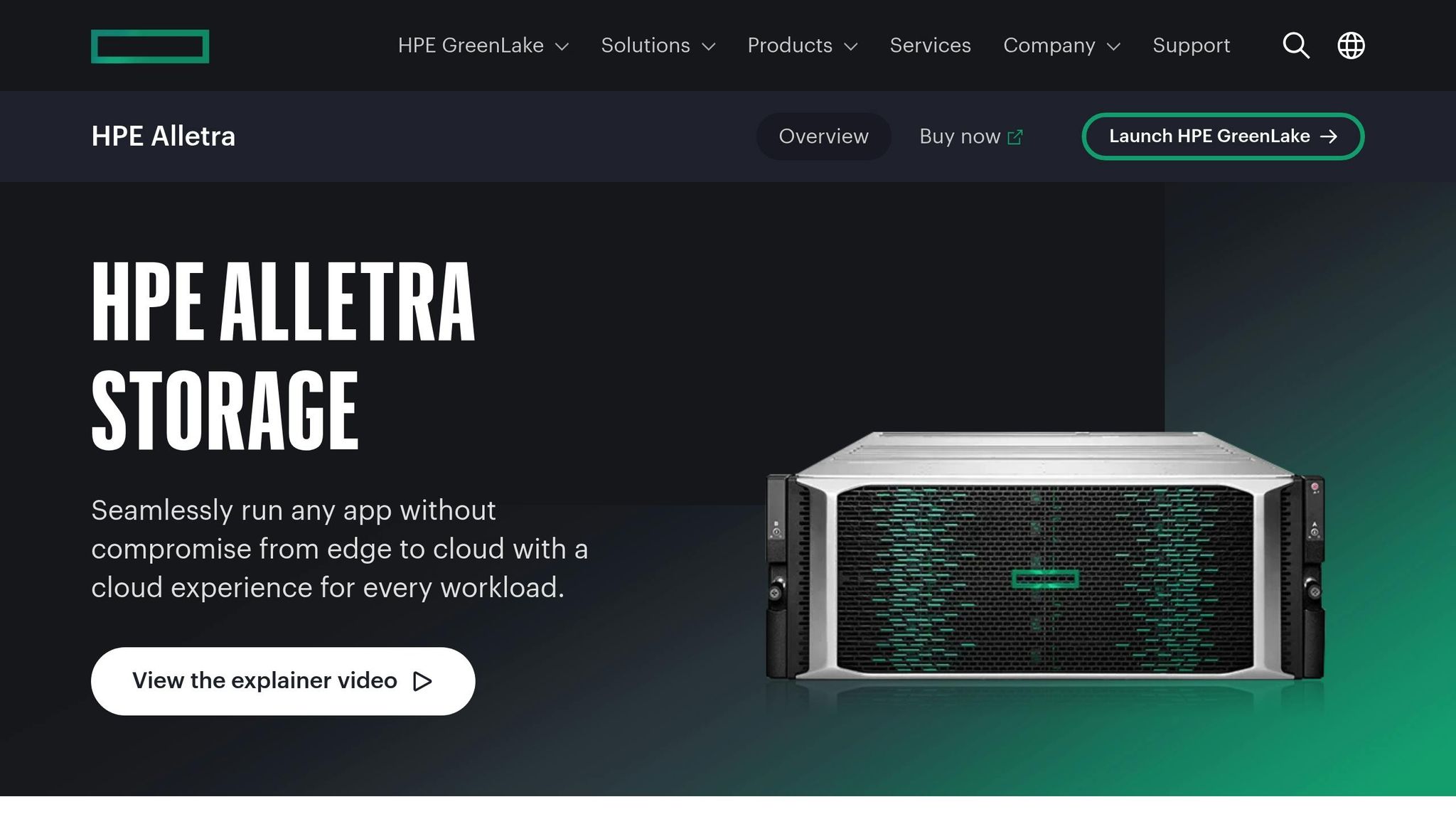
HPE Alletra is the core of HPE’s storage offerings, built to provide modular, cloud-native simplicity with the ability to scale performance and capacity independently. The lineup includes:
- Alletra 5000: Designed for general-purpose workloads, featuring hybrid flash storage.
- Alletra 6000: Optimized for business-critical applications with all-NVMe flash.
- Alletra 9000: Engineered for mission-critical performance, offering over 2 million IOPS and sub-millisecond latency.
At the high end, HPE Alletra Storage MP features a disaggregated, scale-out architecture that supports block, file, and object storage protocols. It offers up to 5.8PB of usable capacity, with separate compute and storage resources for independent scaling and optimization.
The Alletra 6000 delivers three times the speed of earlier Nimble All Flash Arrays, combined with an impressive 99.9999% availability. Users report saving 99% of operational time thanks to automated management and predictive analytics.
With InfoSight integration, Alletra leverages predictive analytics to identify and resolve issues while improving storage efficiency through advanced data reduction techniques like compression and deduplication. Plus, the HPE Store More Guarantee ensures organizations get the most effective capacity per terabyte of raw flash.
HPE GreenLake
HPE GreenLake redefines traditional infrastructure ownership by offering a subscription-based, pay-as-you-go model. This service provides cloud-like flexibility for on-premises and edge environments, allowing businesses to pay only for what they use, similar to public cloud services.
GreenLake is HPE’s fastest-growing business, boasting over $2.8 billion in contract value and serving more than 600 customers globally. It delivers measurable benefits, including a 166% ROI over three years, 65% faster IT deployments, 30% lower capital expenditures, and a 90% reduction in professional services costs.
- HPE GreenLake for Block Storage: Offers enterprise-class storage as a service, built on HPE Alletra Storage MP, with a 100% data availability guarantee.
- HPE GreenLake for File Storage: Provides file storage as a service, ideal for managing large volumes of unstructured data. Pricing is consumption-based, with additional capacity available for growth.
HPE manages the entire system lifecycle, freeing IT teams to focus on strategic priorities. Through HPE GreenLake Central, customers gain a unified view of operations across private and public clouds, as well as edge environments. Additionally, HPE Pointnext professional services assist with implementation, management, and support.
HPE StoreOnce
HPE StoreOnce is a powerful solution for data protection across on-premises and multi-cloud environments. Designed specifically for backup and recovery tasks, it enhances efficiency, security, and performance while reducing complexity and costs.
Key features include:
- Deduplication and data reduction: Reduces backup storage needs by up to 20x, with data reduction rates reaching 95%.
- High-speed backups: Achieves speeds of 105TB/hr and scales to 1.1PB locally or 3.3PB with Cloud Bank Storage.
StoreOnce integrates seamlessly with other HPE storage systems, such as HPE Alletra, HPE SimpliVity, HPE 3PAR, HPE Primera, and HPE Nimble Storage. Using HPE Recovery Manager Central (RMC), it connects primary storage with StoreOnce to deliver faster, more efficient backups – up to 23x faster than traditional methods – and 15x faster restores. RMC also leverages snapshots that can act as independent volumes during disaster recovery.
Deployment options are flexible:
- Physical appliances: Ideal for high-volume environments.
- Virtual appliances (HPE StoreOnce VSA): Provide agility for smaller setups without requiring dedicated hardware. A free 1TB VSA is available for evaluation, allowing teams to test the solution in their environment.
StoreOnce also integrates with leading backup software vendors like Commvault and Veeam for faster, automated data restores. For enhanced security, it can pair with HPE StoreEver Tape to create offline, air-gapped backups, offering protection against ransomware and other cyber threats.
Together, these solutions enable businesses to achieve scalable, secure, and efficient storage management tailored to their unique needs.
sbb-itb-59e1987
Enterprise Use Cases and Benefits
HPE SDS stands out with its advanced features, offering real-world advantages across various enterprise scenarios.
Hybrid and Multi-Cloud Environments
Managing data seamlessly across on-premises, cloud, and edge is a common challenge for enterprises. HPE’s SDS solutions shine in these setups by ensuring smooth data mobility and consistent management no matter where the data lives.
Take Porto Itapoá, for example – one of Brazil’s largest container terminals. By upgrading to HPE Alletra Storage, they boosted daily gate transactions by 67% and scaled their capacity to handle up to two million containers annually. PrairieStar Health Center also leveraged HPE Alletra Storage to transform its IT services, cutting down patient lookup and reporting times, turning IT from a cost center into a strategic advantage. Another success story comes from Balz Informatik AG, which paired HPE Alletra Storage with HPE ProLiant servers to create a smooth edge-to-cloud system. The result? A 2.5x performance increase, reduced costs, and lower operational risks.
HPE GreenLake adds even more value to hybrid setups with its scalable, pay-as-you-go model. These capabilities are especially beneficial for data-heavy applications, as detailed below.
Data-Driven Applications
High-performance storage is a must for AI, analytics, and other data-intensive applications. HPE InfoSight AIOps steps up by offering predictive analytics that help prevent performance hiccups, ensuring systems run smoothly and efficiently.
Cost Savings and Efficiency
HPE’s software-defined storage solutions stand out for their ability to cut costs, streamline operations, and optimize resource use. By separating software from proprietary hardware, organizations can adopt more affordable infrastructure without compromising on performance.
For example, Cengage Group managed to shrink its data footprint by 80% while doubling performance using flash-array hardware. Deploying HPE Nimble Storage led to a 49% reduction in operating costs over five years. On average, organizations reported annual benefits of $3.06 million, with a payback period of just seven months and a 487% ROI over five years.
Thanks to the flexibility of software-defined storage, businesses can quickly adapt storage configurations to meet changing needs. AI-driven automation and predictive analytics further reduce operational overhead while maximizing resource efficiency. Combined with a consumption-based pricing model, HPE SDS solutions offer a cost-effective, high-performance alternative to traditional storage systems, perfectly suited for modern enterprise workloads.
HPE Software-Defined Storage Comparison
Finding the right HPE software-defined storage (SDS) solution means aligning your choice with your workload and infrastructure goals. Each option offers distinct features tailored to specific needs. Below, you’ll find a comparison table and insights to help you decide which solution fits your requirements.
Feature and Use Case Comparison Table
| Feature | Alletra 5000 | Alletra 6000 | Alletra 9000 | Alletra Storage MP | StoreOnce |
|---|---|---|---|---|---|
| Storage Type | Hybrid Flash | All‑NVMe Flash | All‑NVMe Flash | NVMe Multi‑Protocol | Backup & Recovery |
| Primary Use Case | General Workloads | Business-Critical Apps | Mission-Critical Apps | Block, File, Object Storage | Data Protection |
| Performance | 25% faster than HPE Nimble Hybrid | 3x faster than HPE Nimble All‑Flash | 2M+ IOPS, sub‑millisecond latency | High-performance multi‑protocol | Optimized for backup |
| Max Capacity | 368TB | 368TB | 2PB+ | Up to 5.8PB | Varies by model |
| Data Availability | 99.9999% | 99.9999% | 100% Guarantee | 100% Guarantee | High reliability |
| Architecture | Scale‑up | Scale‑up | Scale‑out | Modular, disaggregated | Purpose‑built backup |
| Protocols | iSCSI, Fibre Channel | NVMe/TCP, iSCSI, FC | NVMe/TCP, iSCSI, FC | NVMe/TCP, FC, iSCSI, NFS, SMB | Various backup protocols |
| GreenLake Availability | Available | Available | Available | Exclusive | N/A |
| Ideal For | Cost-conscious deployments | Performance-demanding apps | Ultra-low latency needs | Unified storage management | Data protection & recovery |
Key Insights for Each Solution
Alletra 5000 is a great starting point for organizations moving from traditional storage to software-defined solutions. Its hybrid flash design strikes a balance between cost and performance, making it suitable for general virtualization and standard enterprise applications.
Alletra 6000 takes performance up a notch with all-NVMe flash technology. It’s designed for business-critical applications that require consistent, high-speed performance.
For environments where every millisecond counts, Alletra 9000 offers over 2 million IOPS with sub-millisecond latency. Its scale-out architecture ensures 100% data availability, making it perfect for real-time analytics and other latency-sensitive workloads.
Alletra Storage MP provides a unified approach to block, file, and object storage. With scalability up to 5.8PB, it’s tailored for data-driven enterprises managing diverse workloads under a single, streamlined system.
"3PAR took it to another level, but Alletra and GreenLake have impressed me utterly and totally and made life easier", says Emmanuel Onen, Senior Support Engineer at iOCO.
HPE StoreOnce is purpose-built for backup and recovery, delivering a reliable solution that can reduce backup storage requirements by up to 95%. This makes it indispensable for organizations focused on safeguarding their data.
Pricing and Cost Considerations
HPE offers flexible pricing models to suit different budgets. Traditional Alletra models can be purchased outright (capital expenditure), while HPE GreenLake provides a consumption-based model that adapts to your usage. The Alletra Storage MP, however, is exclusively available through GreenLake’s as-a-service model. Organizations adopting GreenLake often see around 30% savings on total cost of ownership by avoiding costly upgrades.
Whether you need high performance, scalable capacity, or robust data protection, HPE’s SDS solutions provide options tailored to your needs. For mixed workloads, the multi-protocol support of Alletra Storage MP is often a game-changer, while solutions like Alletra 9000 deliver unmatched performance for specific use cases.
Conclusion
HPE’s software-defined storage (SDS) solutions are reshaping how businesses manage their data. By combining flexibility, cost efficiency, and enterprise-grade performance, these solutions help organizations streamline operations while delivering reliable results.
Companies adopting HPE SDS often see immediate financial and operational benefits. Many achieve noticeable cost savings and a fast return on investment, often breaking even within months. Beyond saving money, HPE’s SDS solutions enhance reliability by using predictive analytics to identify and fix issues before they cause disruptions. This proactive approach shifts IT from a reactive role to a strategic driver of business growth.
"HPE customers are realizing significant value by utilizing HPE Nimble Storage to improve their IT agility and application performance and availability. These benefits are worth an average of $3.06 million per year, which would result in a five-year ROI of 487%." – IDC
HPE also excels in supporting businesses navigating hybrid and multi-cloud environments. Solutions like HPE Data Fabric and HPE GreenLake offer the flexibility to handle diverse workloads effortlessly. These tools can reduce virtual machine (VM) licensing costs by up to 90% while speeding up application delivery by as much as 150× – a game-changer for operational efficiency.
Key Takeaways
HPE SDS delivers tangible advantages for enterprises, including rapid payback periods, AI-driven automation for smoother operations, and the flexibility to adapt to changing business needs. To maximize these benefits, organizations should start by evaluating their current storage strategies and conducting a detailed cost–benefit analysis to identify the best-fit HPE SDS solution.
"HPE is reimagining hybrid IT as only we can do, catapulting organizations from the era of hybrid complexity to the era of agentic-AI-powered cloud operations", – Antonio Neri, president and CEO, HPE
The consumption-based model offered by HPE GreenLake is another standout feature. It aligns IT spending with actual usage, often cutting cloud costs by up to 30%. This model also simplifies capacity planning and reduces upgrade expenses, all while offering the flexibility of cloud computing with the control of on-premises systems.
For organizations ready to embrace digital transformation, HPE’s SDS solutions provide a solid foundation for innovation. With a mix of cost efficiency, operational improvements, and strategic adaptability, these tools go beyond being a simple storage upgrade – they become a competitive edge in today’s data-driven world.
FAQs
How does HPE’s software-defined storage improve data management in hybrid cloud environments?
HPE’s software-defined storage transforms data management in hybrid cloud setups by delivering affordable data protection, smooth disaster recovery, and enhanced data mobility. By incorporating AI-driven automation, it fine-tunes performance and simplifies operations, ensuring quicker and more dependable access to critical data.
Through a unified storage platform, HPE allows businesses to manage data seamlessly across on-premises and cloud environments. This reduces operational complexity and supports scalability, making it a great fit for the ever-changing demands of modern enterprises.
How does AI-driven automation improve the performance and efficiency of HPE’s software-defined storage solutions?
AI-powered automation is central to improving HPE’s software-defined storage (SDS) solutions. By simplifying complex data management tasks, it helps minimize latency, improve system performance, and increase efficiency – key benefits for handling demanding workloads like AI applications and hybrid cloud setups.
With AI, HPE’s SDS solutions can anticipate and resolve potential issues before they disrupt operations. This ensures consistent performance and reliability, allowing businesses to concentrate on innovation rather than spending time on manual system oversight.
What are the benefits of HPE GreenLake’s consumption-based pricing model for businesses?
HPE GreenLake’s pricing model is all about paying for what you actually use, which can be a game-changer for businesses. Instead of committing to hefty upfront investments in hardware, companies only cover the cost of the storage resources they consume. This makes it easier to keep budgets on track and ensures spending aligns with real business needs.
What’s more, this approach brings predictable costs, quicker implementation, and the ability to scale resources up or down based on demand. Whether your business is growing rapidly or dealing with fluctuating needs, you can adjust without worrying about expensive infrastructure overhauls. It’s a smart choice for enterprises that need flexibility in today’s fast-paced environment.