
Decentralized Storage: Redundancy Benefits for Enterprises

Decentralized storage offers a different way to store data by distributing encrypted fragments across multiple nodes worldwide. Unlike centralized systems, this approach reduces risks of data loss from single points of failure, hardware issues, or regional disasters. For enterprises, the benefits include:
- High Reliability: Systems like Filecoin, IPFS, Arweave, and Sia ensure data remains accessible even if a portion of nodes fail, leveraging techniques like erasure coding and cryptographic proofs.
- Cost Savings: Decentralized platforms often reduce storage costs through open marketplaces, lower egress fees, and efficient redundancy methods.
- Disaster Recovery: By spreading data across regions, these systems enhance resilience against outages, cyberattacks, or natural disasters.
- Regulatory Compliance: Some platforms allow control over data location to meet data sovereignty laws.
Each platform – Filecoin, IPFS, Arweave, and Sia – has unique strengths, such as permanent storage, customizable redundancy, or cost-efficient fault tolerance. While adoption is growing, challenges like slower retrieval speeds and compliance complexities remain. Enterprises should assess their specific needs to choose the most suitable solution.
1. Filecoin
Redundancy Mechanisms
Filecoin uses a decentralized network to store data, relying on content addressing (CIDs) to eliminate single points of failure. Your data is distributed across multiple storage providers, so even if some nodes go offline, your information stays accessible.
To ensure this redundancy, Filecoin employs Proof-of-Replication (PoRep), a cryptographic system that verifies each storage provider has created a unique, independent copy of your data. This prevents providers from falsely claiming multiple copies of the same data. For businesses managing long-term cold storage archives, PoRep guarantees that data is securely stored in distinct locations.
These systems work together to maintain strong data integrity, supported further by Filecoin’s fault tolerance strategies.
Fault Tolerance
Filecoin enhances reliability with its Proof of Spacetime (PoSt) system, which ensures storage providers continuously maintain the data they store. Providers must regularly submit cryptographic proofs to confirm they still hold the data. Failure to do so results in penalties and loss of collateral, keeping providers accountable.
Because Filecoin operates across various geographic regions and network infrastructures, it avoids the cascading failures often seen in centralized systems. Even if one region experiences disruptions, overall data availability remains intact, offering enterprises a dependable solution.
Cost Efficiency
Filecoin’s decentralized model also brings cost advantages. Its open marketplace allows storage providers to compete on price and location, driving down costs. Enterprises can choose providers based on factors like geographic proximity, pricing, and performance, often achieving lower per-gigabyte costs than traditional cloud storage – especially for large-scale archives.
The platform’s programmable payment system adds another layer of transparency. Payment is made only for services that are successfully delivered. If on-chain proofs reveal a failure, billing automatically pauses, meaning you’re not paying for unavailable storage. This streamlined and auditable billing process not only reduces operational headaches but also helps avoid the unexpected price hikes common with traditional storage providers.
2. IPFS
Redundancy Mechanisms
IPFS brings a unique approach to data storage and accessibility, making it a strong choice for enterprises. When you upload a file to IPFS, it’s broken into smaller blocks, each assigned a unique Content Identifier (CID) derived from the file’s content. This setup ensures that any node holding your data can serve it, removing reliance on a single server or location.
To keep your data accessible, IPFS uses a method called pinning, which stores data on specific nodes. For businesses, this is a game-changer – pinning ensures that vital data remains available even if some nodes go offline. You can pin data on your own infrastructure or use third-party pinning services that operate multiple IPFS nodes across various locations. This guarantees access to your data, even when your devices or systems experience downtime.
Fault Tolerance
The peer-to-peer nature of IPFS eliminates single points of failure by spreading data across multiple nodes. A distributed hash table (DHT) enables any peer in the network to locate and request content from nodes that store it. This decentralized structure shields your data from vulnerabilities tied to centralized systems.
Another key feature is data immutability. Once files are uploaded to IPFS, they can’t be altered or deleted, preserving their integrity over time. The CID verification process ensures that the data you retrieve matches what was originally stored – any changes to the content result in a new CID. This is especially beneficial for enterprises that must maintain accurate audit trails or comply with regulatory standards.
Cost Efficiency
IPFS is cost-effective because it allows enterprises to use their existing infrastructure without additional licensing fees. Its built-in redundancy reduces the need for expensive backup systems or extra hardware, as the network automatically handles data distribution.
For businesses that want reliable data storage without managing their own nodes, pinning services provide a practical solution. While these services come with fees, they are often more affordable than traditional cloud storage, especially for large datasets. You only pay for the storage you use, and the decentralized nature of IPFS minimizes costs tied to maintaining centralized data centers, such as utilities, hardware upkeep, and bandwidth. Up next, we’ll examine more platforms.
3. Arweave
Redundancy Mechanisms
Arweave introduces a storage model that’s designed to last, leveraging its blockweave technology – a multidimensional spin on traditional blockchain systems. When you store data on Arweave, you pay a one-time fee in AR tokens. This upfront cost ensures storage for an impressive minimum of 200 years, thanks to an endowment that covers both initial mining and ongoing storage.
The network operates on a Proof-of-Access (PoA) consensus mechanism, which motivates miners to retain as much historical data as possible. To add new data, miners must demonstrate access to randomly selected historical blocks. This ensures data is replicated across the network extensively. The likelihood of a single block becoming unavailable is so minuscule – 4.498×10^-290 – that it’s practically impossible. Even with a drastic drop in replication to just 20%, the probability of data loss is still an incredibly small 0.000000000000000829. This high level of redundancy means Arweave is built for durability.
Fault Tolerance
Arweave validates data every 14.4 seconds – more than 5,670 checks daily. Sam Williams, the founder of Arweave, highlighted this robust system:
More than 5,670 validations of your data transaction every day going forward. That means the integrity of your data will be checked once every 14.4 seconds.
To further enhance reliability, Arweave employs the Wildfire protocol. This protocol encourages nodes to share data actively by ranking peers based on their responsiveness and generosity. Nodes prioritize communication with higher-ranked peers, creating a network where data spreads quickly and efficiently. This approach minimizes risks associated with single points of failure, ensuring data availability across the network.
Cost Efficiency
Arweave’s pricing model is built on the assumption of a conservative -0.5% annual decline in storage costs, ensuring long-term affordability. For just $1.00, you can permanently store approximately 400 photos or 3,500 office documents.
Enterprise Reliability
Arweave’s real-world adoption highlights its reliability for businesses. In 2023, Meta integrated Arweave to permanently store digital collectibles, such as NFTs, on Instagram as part of its Web3 initiatives. By October 14, 2025, blockchain projects like Solana and Polkadot had also adopted Arweave for ledger storage, enhancing the security and auditability of their data. Even the Internet Archive uses Arweave for preserving online content. With a growing endowment supporting its operations, Arweave demonstrates not only technological strength but also financial sustainability, making it a trusted choice for enterprise-level storage needs.
Distributed Data: An Introduction to Decentralized Data Storage
sbb-itb-59e1987
4. Sia
Sia stands out among decentralized platforms with its unique methods for ensuring data redundancy and fault tolerance.
Redundancy Mechanisms
Sia employs a clever strategy to safeguard your data by breaking files into smaller chunks. These chunks are processed with Reed-Solomon erasure coding, resulting in 30 unique 4MB pieces. Each piece is encrypted using Threefish encryption and distributed across 30 different hosts within the network. Here’s the impressive part: you only need 10 of these 30 pieces to rebuild your file. This means that even if 20 hosts go offline, your data remains intact, thanks to its 3:1 redundancy setup.
To add another layer of protection, Sia includes an automatic re-duplication feature. If one of the hosts storing your data goes offline, the missing piece is recreated and stored on a new host the next time you run your Sia client. This self-healing process ensures your data always maintains its intended redundancy without requiring you to step in.
Fault Tolerance
Sia’s fault tolerance is deeply tied to its economic model. Storage providers are required to stake Siacoins as collateral before they can host data. If they fail to meet uptime requirements or lose renter data, they lose this collateral. This creates a powerful financial incentive for hosts to maintain at least 98% uptime, ensuring near-constant availability.
The system also relies on contract-based agreements with multiple hosts to specify storage durations. These contracts renew automatically, but renters must check in with their Sia client at least once a month with an unlocked wallet. This monthly check-in is crucial to refresh allowances, renew contracts, and maintain the health of stored files. If renters skip this step, contracts can expire, potentially leading to data loss.
Cost Efficiency
Sia operates as a decentralized marketplace where storage providers compete for users, naturally driving prices lower. Its nonprofit foundation model keeps costs competitive compared to traditional centralized storage options. To optimize costs, users can bundle small files together to avoid the 40MB minimum file size padding. This pricing structure makes Sia a practical and cost-effective solution for enterprises looking for decentralized storage.
Advantages and Disadvantages
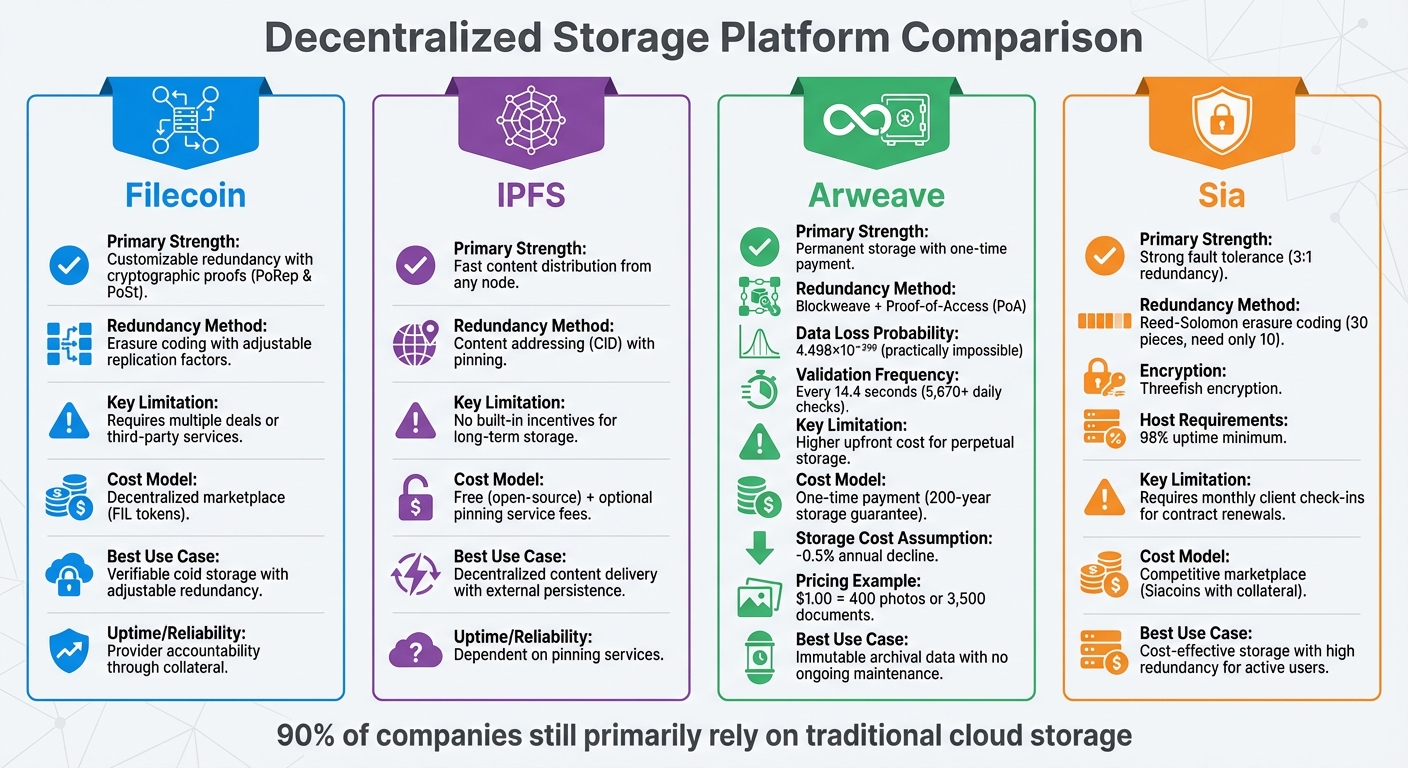
Decentralized Storage Platforms Comparison: Filecoin vs IPFS vs Arweave vs Sia
Looking at the platforms discussed earlier, it’s clear that decentralized storage solutions come with their own set of strengths and weaknesses, especially when it comes to redundancy and reliability.
Filecoin offers a flexible, market-driven approach to redundancy. Enterprises can specify erasure coding and set replication factors for their data. However, achieving the highest level of redundancy often means juggling multiple storage deals or relying on third-party services. IPFS, on the other hand, shines in content distribution. It allows data retrieval from any node holding a copy, but it lacks built-in incentives for long-term storage. This makes it dependent on external pinning services or additional incentive layers to ensure data persistence. Arweave takes a different approach with its one-time payment model for permanent storage. Its Wildfire algorithm quickly replicates files across the network, while the Proof-of-Access mechanism encourages nodes to store older blocks. Meanwhile, Sia offers robust fault tolerance with its 3:1 redundancy model (only 10 out of 30 pieces are needed to recover data). However, it requires regular client activity to maintain data health and renew contracts, which can add to operational overhead.
When comparing these platforms, it’s also important to consider broader challenges that decentralized storage faces. For instance, data retrieval can be slower because nodes are spread across the globe. While edge computing and caching strategies can help, they don’t entirely eliminate the issue. Implementing these systems is also complex, requiring specialized expertise. Compliance with regulations like GDPR, CCPA, and HIPAA further complicates adoption, especially for enterprises operating across different regions. It’s worth noting that 90% of companies still primarily rely on traditional cloud storage, which highlights the hurdles decentralized solutions need to overcome to achieve mainstream adoption.
Cost structures also differ significantly across platforms. Filecoin operates on a decentralized marketplace where miners set prices in FIL, while Sia uses Siacoins with pricing influenced by collateral requirements. Arweave uses a one-time payment model calculated based on an estimated 200-year storage cost, determined by network difficulty. IPFS itself is free to use, but external pinning services come with additional costs.
| Platform | Primary Strength | Key Limitation | Best Use Case |
|---|---|---|---|
| Filecoin | Customizable redundancy with cryptographic proofs | Requires multiple deals or third-party services | Verifiable cold storage with adjustable redundancy |
| IPFS | Fast content distribution from any node | No built-in incentives for long-term storage | Decentralized content delivery with external persistence |
| Arweave | Permanent storage with a one-time payment | Higher upfront cost for perpetual storage | Immutable archival data with no ongoing maintenance |
| Sia | Strong fault tolerance (3:1 redundancy) | Requires periodic client action for contract renewals | Cost-effective storage with high redundancy for active users |
These factors are crucial for enterprises when deciding how to integrate decentralized storage into their operations. Each platform has distinct advantages and trade-offs, making the choice highly dependent on specific business needs and priorities.
How Enterprises Use Decentralized Storage
Enterprises are tapping into decentralized storage to achieve greater data redundancy and reliability. A key example is blockchain hosting, which requires constant uptime and synchronized data for critical blockchain nodes. Companies like Serverion play a vital role here, offering Blockchain Masternode hosting services through their extensive network of 37 data centers spread across the US, EU, and Asia. This global infrastructure ensures uninterrupted operations, even during crisis situations.
Decentralized storage also shines in disaster recovery. By breaking data into encrypted fragments and storing them across multiple nodes in different locations, organizations can bounce back quickly from disasters, outages, or cyberattacks. With networks that include thousands of enterprise-grade nodes, the risk of a single point of failure is drastically reduced, and recovery times are much shorter compared to traditional single-location backups.
Another major advantage is cost efficiency, especially for data archiving. Decentralized storage can lower archival costs by as much as 80%, making it an ideal solution for meeting regulatory and long-term data retention requirements without duplicating entire datasets. Moreover, many enterprises are adopting S3-compatible decentralized storage as a seamless replacement for their existing object storage. This plug-and-play approach simplifies integration while also delivering faster performance. In fact, some tests have shown download speeds up to 42% faster than AWS for 5MB files, thanks to data retrieval from the nearest node.
Conclusion
Decentralized storage systems bring a new level of reliability to enterprises, thanks to efficient redundancy techniques. Unlike traditional full replication, which demands multiple copies of data, modern approaches like Reed-Solomon encoding achieve security with much less storage overhead.
When it comes to choosing the right platform, it all boils down to your enterprise’s specific needs. If your priority is maintaining high data integrity and availability, look for systems equipped with strong challenge mechanisms and Byzantine fault tolerance to safeguard your data.
In environments where nodes frequently come and go, advanced erasure coding can be a game-changer, significantly cutting down recovery costs compared to older methods. For privacy and security, platforms offering end-to-end encryption and geographically distributed nodes make unauthorized access far more difficult.
For long-term storage, the choice depends on the dataset size. Blockchain-based solutions work well for smaller, immutable datasets, whereas contract-based platforms with incentive layers are better suited for managing larger volumes of data.
FAQs
How does decentralized storage enhance disaster recovery for businesses?
Decentralized storage offers a game-changing approach to disaster recovery by eliminating the vulnerabilities tied to traditional centralized systems. Instead of storing files in a single location, this method breaks them into smaller fragments, distributes them across independent nodes globally, and safeguards them with redundancy measures. This setup ensures that even if some nodes are affected by outages, hardware failures, or cyberattacks, your data remains accessible and intact.
For businesses, this translates to quicker and more reliable data recovery during emergencies – without the hefty costs of maintaining duplicate backups in separate facilities. With built-in redundancy, data encryption, and automatic recovery features, decentralized storage meets strict recovery objectives while reducing downtime and financial risks. Companies leveraging Serverion’s decentralized storage solutions gain access to these advanced disaster recovery benefits, ensuring their operations stay protected and uninterrupted.
What are the cost benefits of decentralized storage for enterprises?
Decentralized storage platforms like Filecoin and Sia offer a compelling alternative to traditional cloud providers, especially when it comes to cost savings. While services such as Amazon S3 or Microsoft Azure typically charge $16–$23 per terabyte per month, decentralized options can lower that expense to around $4 per terabyte per month. Even when accounting for additional upload and retrieval fees, these platforms remain a budget-friendly solution, particularly for archival or backup storage.
The cost efficiency comes from their innovative approach to redundancy. Take Sia, for example – it splits files into 30 encrypted shards and distributes them across different hosts. Remarkably, only 10 shards are needed to reconstruct the file. This method avoids the need for full duplicate copies, drastically reducing the storage space required. By leveraging a global network of independent storage providers, businesses can tap into unused capacity at competitive rates while still ensuring data reliability and security.
How do decentralized storage systems ensure compliance with regulations and data sovereignty requirements?
Decentralized storage systems tackle compliance and data sovereignty challenges by splitting encrypted files into fragments and spreading them across various independent nodes. These fragments, often called shards, are safeguarded with end-to-end encryption, ensuring that only the data owner can access them. This approach aligns seamlessly with privacy laws like GDPR and CCPA. Many platforms also let organizations define geographic boundaries, ensuring that data stays within specific regions as required.
For U.S.-based businesses, using a provider like Serverion – with its U.S.-based data center options – can make adhering to federal and state residency laws much easier. Features such as regional node selection, enterprise-controlled encryption keys, and detailed storage activity logs enable organizations to meet regulatory standards while enjoying the durability and redundancy that decentralized storage offers.