
How To Market Reseller Hosting Services

Reseller hosting allows you to sell hosting services under your brand without managing the technical infrastructure. It’s a growing market, with the web hosting industry valued at $126.41 billion in 2024 and expanding by nearly 20% annually. To succeed, you need more than just a good product – you need effective marketing strategies that highlight your offerings and attract the right customers.
Key takeaways:
- Focus on benefits, not technical specs: Highlight outcomes like faster page loads or reliable uptime instead of jargon like "NVMe SSD storage."
- Target specific audiences: Cater to niches like web design agencies, small businesses, or WordPress developers with tailored packages.
- Leverage local SEO and content marketing: Use high-intent keywords, optimize your Google Business Profile, and create educational blog content.
- Build trust: Collect reviews, provide excellent customer support, and showcase performance metrics like uptime and speed.
- Expand through partnerships: Collaborate with web agencies and developers or launch referral programs to grow your customer base.
10 Reseller Hosting Marketing Tricks That Actually Work!
Creating Competitive Reseller Hosting Packages
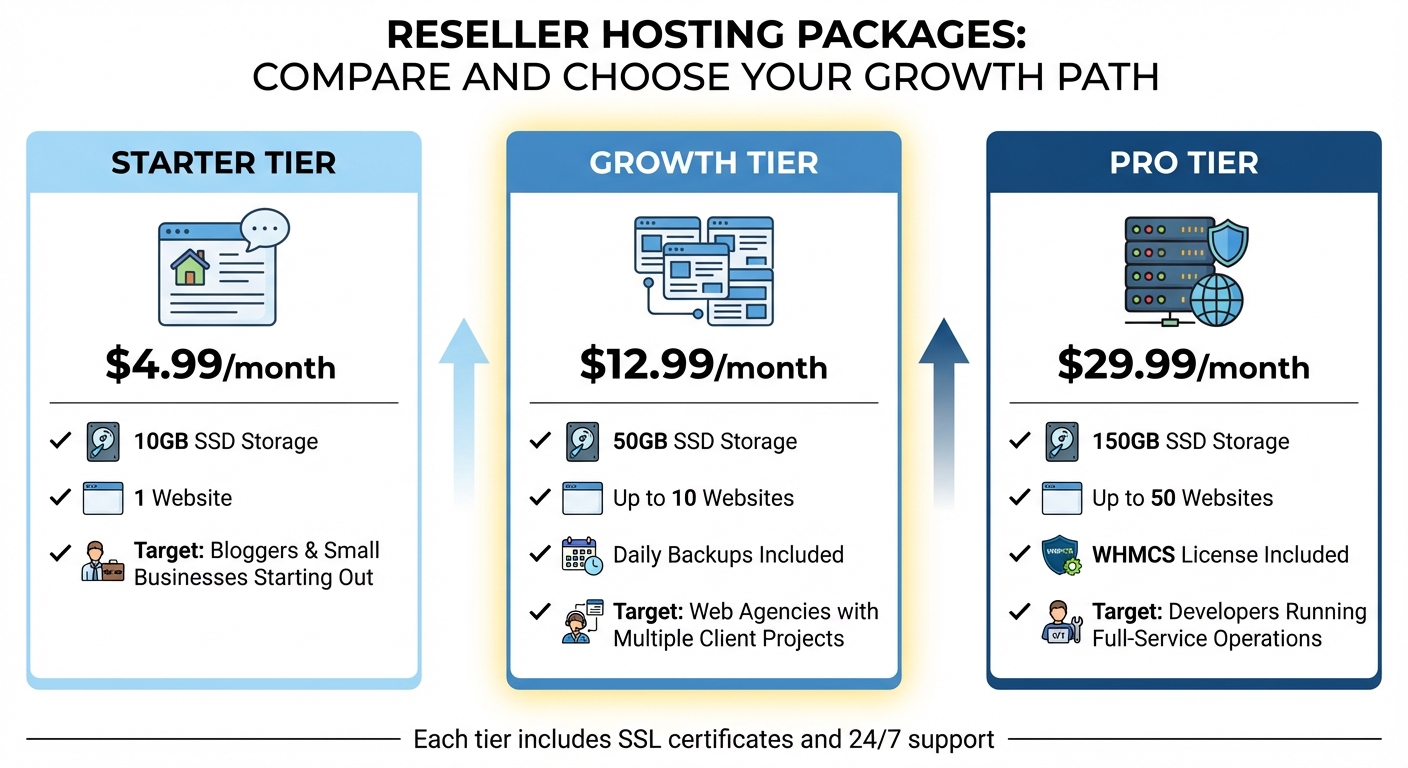
Reseller Hosting Package Tiers Comparison Chart
When crafting reseller hosting packages, focus on the benefits your clients will gain rather than just listing technical specs. For instance, instead of saying "50GB SSD storage", present it as part of a "Growth Plan" that can handle traffic surges during key events like product launches. This approach makes your offerings more relatable and appealing.
Designing Packages for Different Client Needs
To cater to a variety of customers, design packages that align with specific user profiles. Here’s an example of how you could structure your tiers:
- Starter Tier: At $4.99/month, this plan includes 10GB of SSD storage and support for one website. It’s perfect for bloggers or small businesses just starting out.
- Growth Tier: For $12.99/month, this package offers 50GB of SSD storage, support for up to 10 websites, and daily backups. It’s ideal for web agencies juggling multiple client projects.
- Pro Tier: Priced at $29.99/month, this plan provides 150GB of SSD storage, support for up to 50 websites, and a WHMCS license. It’s tailored for developers running comprehensive, full-service operations.
Each package should clearly showcase the added benefits of upgrading, making it easy for clients to see the value in moving to a higher tier. This tiered approach also enables you to target specific niches effectively. For example:
- Digital agencies may require multi-site hosting with white-label branding.
- E-commerce stores often prioritize strong security and high performance.
- Local businesses like restaurants or real estate offices may prefer simple, low-maintenance solutions.
By tailoring packages to these needs, you can offer extras like SSL certificates, domain registration, or website maintenance services. These add-ons not only solve real problems for clients but also increase your profit margins.
Once your packages are in place, emphasize how Serverion’s infrastructure enhances their value.
Promoting Serverion Reseller Hosting Features
Serverion’s infrastructure offers strong selling points that resonate with client priorities. Their global data centers in the U.S., Europe, and Asia ensure faster load times for customers targeting specific regions. Features like DDoS protection and 24/7 monitoring address real-world concerns about uptime and reliability far better than a list of specs ever could.
For example, when leveraging Serverion’s VPS Small plan ($10/month with 1 core, 2GB RAM, 50GB SSD) or Webhosting Small option ($30/year for 500MB space), highlight the 99.9% uptime guarantee and dependable support. These features keep client websites running smoothly, which is what truly matters to them.
"Clients care about speed, uptime, and real support, not specs." – Carrie Smaha, Senior Manager Marketing Operations, InMotion Hosting
Take advantage of Serverion’s white-labeling options to ensure your brand – not theirs – is front and center. This builds trust in your business while letting you leverage enterprise-grade infrastructure to enhance your market presence. Additionally, offering free migration services can ease the transition for potential clients, removing a common barrier to switching and turning prospects into long-term customers.
Finding and Reaching Your Target Customers
Successful marketing starts with understanding your audience – especially when promoting reseller hosting services. Building a loyal customer base requires identifying who benefits most from what you offer. Instead of casting a wide net, focus on specific groups like web design agencies, WordPress developers who need reliable hosting, and small local businesses looking for personalized support. Each group has unique priorities: agencies might value white-label solutions, developers often need technical flexibility, and small businesses typically prioritize simplicity and local service. By narrowing your focus, you can create marketing messages that resonate.
Defining Your Target Audience
To connect with your audience, develop detailed customer profiles based on their specific needs. For instance, a web agency managing 20+ client websites may prioritize features like bulk management tools and automated backups. On the other hand, a local bakery owner might just want a fast, hassle-free website. Recognizing these differences helps you shape everything from your package offerings to your promotional strategies.
Specializing in a niche can also give you a competitive edge. For example, you could target WordPress agencies or e-commerce businesses exclusively, allowing you to refine your services and marketing efforts. As WordPress expert Javeria Riaz wisely points out:
"The better you know the people you’re trying to help, the more effective your business can be."
The numbers back this up. With around 2 billion websites worldwide as of 2022 and the web hosting market expected to hit $216 billion by 2025, there’s plenty of room to carve out a profitable niche.
Once you’ve defined your audience, focus your efforts on reaching them both locally and online.
Using Local SEO and Online Targeting
Local SEO can give you a big advantage by helping you connect with customers in your area. Start by creating and optimizing your Google Business Profile. Include your business address, phone number, and clear descriptions of your services. Businesses with complete profiles are 70% more likely to attract customer visits. Plus, with 57% of local searches happening on mobile devices, being visible online is a must.
Use high-intent keywords like "white-label hosting with free migrations" or "reseller hosting for WordPress agencies in [Your City]." These targeted phrases attract potential customers who already know what they need and are ready to buy. Dedicated landing pages for specific service areas, along with local case studies and testimonials, can further boost your chances of converting leads by addressing location-specific concerns.
Don’t underestimate the power of online reviews. Encourage happy local clients to leave feedback on platforms like Google and Facebook. Positive reviews build trust, especially with small business owners who prefer working with providers nearby. Additionally, get involved in local online communities – like Facebook or LinkedIn groups for web design or small business growth. Sharing helpful advice and insights here can position you as a go-to expert in your area.
Building Your Brand and Online Presence
A strong brand identity sets you apart from competitors and establishes credibility before a potential customer even looks at your pricing. Your brand goes beyond just a logo – it’s the entire experience people have when interacting with your business, from the design of your website to the tone of your customer support.
Creating a Professional Brand Identity
One of the first steps is to use white-label branding through WHM (Web Host Manager) to remove any mention of your parent hosting provider. Replace default cPanel screens with your own logo and color scheme. As Christopher Maiorana from InMotion Hosting explains:
"Rebranding confirms that you are the primary contact for customer needs."
This small but impactful move reinforces the idea that you are the provider, not just a middleman. Beyond this, design a unique logo and ensure your visual style is consistent across your website, social media, and email communications.
When presenting your hosting packages, avoid technical jargon like "NVMe SSD storage" or "unlimited bandwidth." Instead, explain how these features benefit your customers. For example, name your plans something relatable like "Launch Plan" for startups or "Campaign-Proof Plan" for e-commerce businesses expecting traffic surges. Replace terms like "includes NVMe SSD" with something clear and customer-focused, such as "keeps your customers’ sites fast, even during peak traffic." Carrie Smaha from InMotion Hosting sums it up:
"A fast site doesn’t just look professional, it drives conversions."
Your website’s performance is also a key part of your brand. Strive for load times under one second by leveraging NVMe storage, caching, and CDNs. A slow-loading site can give prospects the impression that their own sites will perform poorly with your service. Use real data – like speed test results and uptime graphs showing 99.99% reliability – to back up your claims. Visual evidence often speaks louder than marketing copy.
A well-defined brand identity naturally extends into your content strategy, further building trust with potential customers.
Using Content Marketing to Educate and Attract Leads
Once your brand is solidified, your content needs to reflect your expertise and reliability. By aligning your content with your tailored packages and target audience, you can consistently deliver on the promises your brand makes.
Educational content is a great way to position yourself as an expert while attracting customers who are actively seeking solutions. Start a blog that tackles real-world hosting challenges your audience faces. Topics like "How to install SSL certificates", "Why website speed affects sales", or "Understanding DNS management for beginners" can draw in readers looking for help. With over 64% of small businesses using newsletters, sending regular email updates can keep your brand in front of your audience without being overly salesy.
Structure your content to guide potential customers through their decision-making process. Use educational posts for awareness, comparisons for consideration, and transactional pages for conversion. For example, a blog post on domain management can link directly to your domain registration services, subtly showcasing your offerings while helping readers solve a problem.
To simplify technical concepts, use infographics or short explainer videos. These visual tools make topics like server resources or DNS configuration easier to digest. Share case studies of successful clients to provide social proof, and don’t shy away from showing behind-the-scenes insights, like "We tested three caching setups; here’s what worked." Authenticity often resonates more than overly polished updates.
Stay active on social media by posting three times per week on platforms like LinkedIn or Facebook groups where your target audience gathers. Participate in forums and CMS-related communities by offering helpful advice without immediately pitching your services. This builds trust and positions you as a reliable resource. As Nile Flores from Verpex notes:
"People are loyal to brands that are unique and memorable. They will care and trust what you are doing, and be happy to interact with you, but also buy from you."
sbb-itb-59e1987
Using Paid Advertising and Social Media
Once you’ve established a solid content strategy and built a recognizable brand, paid advertising and social media can help you scale faster. These tools enable you to reach potential customers actively searching for hosting solutions. The trick? Target with accuracy and avoid wasting your budget on broad, unfocused campaigns.
Running Targeted Google Ads Campaigns
Google Ads delivers the best results when campaigns are segmented by user intent. Instead of lumping all searches into one campaign, divide your audience into groups like price-sensitive buyers, small businesses prioritizing reliability, or non-technical users looking for managed solutions. Each group has unique needs, so your ad copy should reflect that.
Zero in on keywords that show purchase intent. For example, phrases like "Best WordPress hosting for ecommerce" or "Affordable VPS with cPanel" attract users closer to making a decision. These keywords typically cost less per click and convert better than generic terms like "web hosting." To further refine your traffic, use negative keywords – for instance, exclude "free" if you’re not offering free trials, so you avoid clicks from users unlikely to convert.
Organize your ad groups around tightly focused keywords and craft ad copy that directly addresses specific pain points. For example, instead of a generic message like "Reseller Hosting Plans Available", try something more compelling: "Launch Your Hosting Business in 24 Hours – White-Label Ready." This speaks to a clear need while creating urgency. Highlight your Serverion-powered infrastructure to emphasize reliability. Regularly review your campaigns, adjust bids, and pause underperforming ads to keep acquisition costs in check.
While targeted ads bring in ready-to-buy customers, social media helps you build trust and long-term relationships.
Engaging Customers on Social Media
Social media isn’t just about visibility – it’s a powerful way to connect directly with B2B clients who need hosting solutions. Platforms like LinkedIn are especially effective for reseller hosting, as they connect you with web agencies, developers, and IT consultants managing hosting for their clients. Balance your posts with a mix of educational content (like tips on bandwidth throttling), evidence-based updates (such as screenshots of 99.99% uptime), and behind-the-scenes glimpses to add a human touch to your brand.
Platforms like X (formerly Twitter) and Threads are ideal for quick interactions and participating in industry conversations. Meanwhile, Facebook groups focused on web design, SEO, or CMS communities are excellent spaces to find prospects dealing with hosting challenges. Spend just 15 minutes a day answering technical questions in these groups – without pushing your services right away. This builds credibility and trust, making it easier to convert leads when the time comes.
Maximize your content’s reach by repurposing it across multiple formats. For example, turn a single blog post into a LinkedIn carousel, a quote image, a vertical video for YouTube Shorts, and a discussion topic for Facebook groups. Visual proof, like before-and-after load-time improvements or migration success stories, resonates more than generic claims. To drive action, include limited-time offers – such as first-month discounts – in your posts, giving prospects a reason to act immediately.
These social interactions position you as the go-to reseller hosting expert backed by enterprise-grade solutions.
Building Partnerships and Referral Programs
When it comes to growth, partnerships and referrals can be game-changers. They allow you to tap into trusted networks, giving your business a head start. For example, when a web designer recommends your hosting service to their client, you’re not just another option – you’re already seen as credible.
Partnering with Web Agencies and Developers
Web agencies and developers are perfectly positioned to help expand your reach. These professionals often manage multiple client sites but prefer to avoid the hassle of server management. That’s where you come in. Focus on WordPress experts, e-commerce agencies, and local web designers who need dependable hosting solutions without the technical complexity. Frame your service as a way for them to earn recurring revenue while you handle the heavy lifting.
White-label features can be a game-changer here. They let agencies maintain their branding while relying on your infrastructure. For instance, Serverion provides the backend support, but agencies get the credit for reliability and performance. If they manage several clients, consider offering Master Reseller capabilities, allowing them to run their own hosting businesses independently.
For outreach, LinkedIn is your go-to platform, especially since it generates 80% of B2B social media leads. Use tools like Expandi or LinkedHelper to identify agency owners, but keep your approach friendly and helpful. Instead of a hard sell, offer something useful upfront – like free speed audits. Use metrics like LCP (Largest Contentful Paint), CLS (Cumulative Layout Shift), and TTFB (Time to First Byte) to show how their clients’ sites could perform better on your hosting platform. Also, create co-branded marketing materials – email templates, performance reports, and one-sheets – that agencies can use with their clients.
Building relationships locally can also pay off. Partner with graphic designers by offering hosting services in exchange for web design leads. Host webinars or Q&A sessions for agencies, showing them how to profit from white-label hosting without adding to their workload. The goal isn’t to close the deal immediately – it’s to become their go-to technical partner.
At the same time, don’t underestimate the power of a good referral program.
Creating a Referral Program
Happy customers can become your best marketers if you make it easy and rewarding for them. A tiered incentive program works well: for example, “Refer three clients and get a free month of hosting.” It’s simple, achievable, and motivates action.
You can also offer cash rewards or service upgrades, like $25 per sign-up or bonus storage. Experiment to see what works best. Dropbox famously grew by giving users extra storage for referrals, aligning the reward with what their audience valued most. Similarly, Casper offered a 30% discount to both referrers and new customers, creating a win-win situation that encouraged participation.
Simplify the referral process with tools like one-click email templates and shareable landing pages. Software like WHMCS can automate tracking, invoicing, and account setup, making the whole process seamless. Timing is key, too – ask for referrals when customers are happiest, like after a successful website launch or a great support experience.
Keep an eye on the numbers. Track the conversion rates of referred leads against the cost of rewards to make sure the program is profitable. With reseller hosting margins often between 40% and 70%, and a single client paying $50/month bringing in $600 annually, even generous incentives can pay for themselves quickly. Don’t forget to show appreciation – personalized thank-you notes or shout-outs on social media can go a long way in keeping the referrals coming and building loyalty.
Building Customer Trust Through Reviews and Support
Once you’ve established a strong brand identity, the next step is earning your customers’ trust. For a reseller hosting business, where there’s no physical storefront, trust is built entirely online. This makes reviews and responsive support your most effective tools for winning over potential customers. When specs are similar across providers, social proof often becomes the deciding factor.
Collecting and Displaying Customer Reviews
Customer reviews are more influential than you might realize. 90% of consumers base their decisions on reading up to ten reviews, and while most people won’t leave a review on their own, over 50% will if you simply ask.
Make it easy for happy customers to leave public reviews while giving dissatisfied ones a private way to share their concerns. Tools like Starfish Reviews for WordPress can help by directing satisfied customers to platforms like Google or Trustpilot, while routing unhappy ones to a private feedback form. This strategy not only protects your reputation but also ensures you’re collecting genuine testimonials.
To build trust, focus on gathering detailed, authentic reviews from verified users. Adding visual proof – like uptime graphs showing 99.99% reliability, Core Web Vitals screenshots, or speed test results – can further validate your service. When prospects see both performance data and customer testimonials, they get a complete picture of what you offer. Reviews on third-party platforms like Google, Yelp, or Trustpilot often carry more weight than those on your own site, as they’re seen as unbiased.
While reviews establish your credibility, responsive customer support strengthens it during critical moments.
Providing 24/7 Customer Support
Support isn’t just about solving problems – it’s about showing your customers that their time matters. 82% of consumers expect an immediate response to support requests, with "immediate" defined as under 10 minutes. Meeting this expectation can quickly build loyalty. Interestingly, 81% of customers try to resolve issues on their own first, which is why a comprehensive knowledge base is essential.
Offer a variety of support channels to cater to different needs:
- Live chat or phone: Ideal for urgent issues like a site outage, providing fast resolutions and a personal connection.
- Ticket systems: Best for complex problems that require in-depth investigation, offering a documented trail for reference.
- Knowledge base: Perfect for general "how-to" questions and setup guides, available 24/7 for self-service help.
- Chatbots: Useful for gathering initial information and scheduling callbacks, ensuring quick acknowledgment of customer concerns.
| Support Channel | Best Use Case | Customer Benefit |
|---|---|---|
| Live Chat / Phone | Urgent technical issues (e.g., site down) | Immediate resolution and human interaction |
| Ticket System | Complex queries needing investigation | Clear communication and specialized handling |
| Knowledge Base | General troubleshooting or setup help | 24/7 access and self-paced learning |
| Chatbots | Initial inquiries and callbacks | Quick acknowledgment and streamlined process |
Additionally, consider sharing quarterly performance reports that highlight uptime, speed metrics, and recent improvements. This proactive communication not only reinforces your reliability but also provides customers with tangible evidence they can share with their own clients. It’s a simple way to strengthen loyalty and keep your customers engaged.
Conclusion
Succeeding in reseller hosting marketing boils down to clear positioning and consistent effort. In a competitive and growing market, focusing on results-oriented packaging, tailored messaging, and building trust is key.
Here’s a real-world perspective to keep in mind:
"Getting your first few customers is easy. Reaching 1,000 takes consistency and clear positioning."
- InMotion Hosting
When creating hosting packages, emphasize what clients care about most – uptime, speed, and security – instead of overwhelming them with technical specs like disk space. Using white-label branding lets you present everything under your own identity, helping you stand out. Specializing in a niche, such as local small businesses or creative agencies, can further reduce competition and allow you to address specific needs more effectively.
Your marketing efforts should work together seamlessly. Combine strategies like local SEO, content marketing, and targeted Google Ads with platforms like LinkedIn, where 80% of B2B social media leads are generated. While paid campaigns can deliver quick results, don’t underestimate the value of organic growth – quality content and customer reviews build long-term trust and authority.
FAQs
What niche should I target first?
The smartest way to start is by targeting a niche where you can highlight your expertise and make an impact. Consider focusing on areas like small businesses, local companies, or specific industry sectors. By narrowing your audience, you can fine-tune your marketing strategies, position yourself as a specialist, and appeal to clients looking for tailored, industry-focused solutions. Beginning with a well-defined market not only helps you establish trust but also makes it easier to keep customers coming back.
How do I price my reseller hosting plans?
To set prices for reseller hosting plans, start by calculating all your costs – this includes server expenses, software licenses, and the time spent on support. Once you have a clear picture of your expenses, look at what competitors are charging. This helps you position your pricing to stay competitive while still turning a profit.
Consider using pricing strategies that resonate with customers. For instance, rounded numbers or special limited-time offers can make your plans more appealing. Don’t forget to regularly revisit your pricing structure to account for overlooked expenses like backups or security features. This ensures your rates match both the quality of your service and the value you provide.
Which marketing channel should I start with?
Blogging is a great starting point. It allows you to share content that resonates with potential customers, showcases your knowledge, and addresses their common concerns. Beyond that, blogging boosts your online presence, making it a powerful tool for promoting your reseller hosting services. By crafting posts that are both helpful and relevant, you can build trust and foster meaningful connections with your audience.