Redundant Data Centers: Cost Trends in Scalability

Maintaining 99.999% uptime in 2026 isn’t cheap. Data center construction costs now average $11.3M per megawatt (MW), with AI-optimized facilities exceeding $20M per MW. Rising demand for gigawatt-scale capacity, driven by AI workloads projected to account for 50% of data center demand by 2030, is reshaping scalability and redundancy strategies.
Key takeaways:
- Construction Costs: $494M average project cost; Tier IV facilities cost 40% more than Tier III.
- Operational Costs: Power costs surged 267% in five years, with grid delays and supply chain issues adding challenges.
- Scalability Solutions: Modular designs, sequential phasing, campus-level redundancy, and brownfield redevelopment offer cost-effective paths.
- Future Trends: Liquid cooling, prefabricated construction, and on-site energy generation are transforming infrastructure planning.
As power costs dominate budgets and grid constraints slow expansion, smarter designs and planning are critical to staying ahead in this rapidly evolving space.
Navigating Uncertainty in Data Center Pricing
Current Cost Landscape for Redundant Data Centers
Data Center Construction and Operational Costs 2026: Key Statistics and Regional Investment
Key Cost Drivers in Redundant Infrastructure
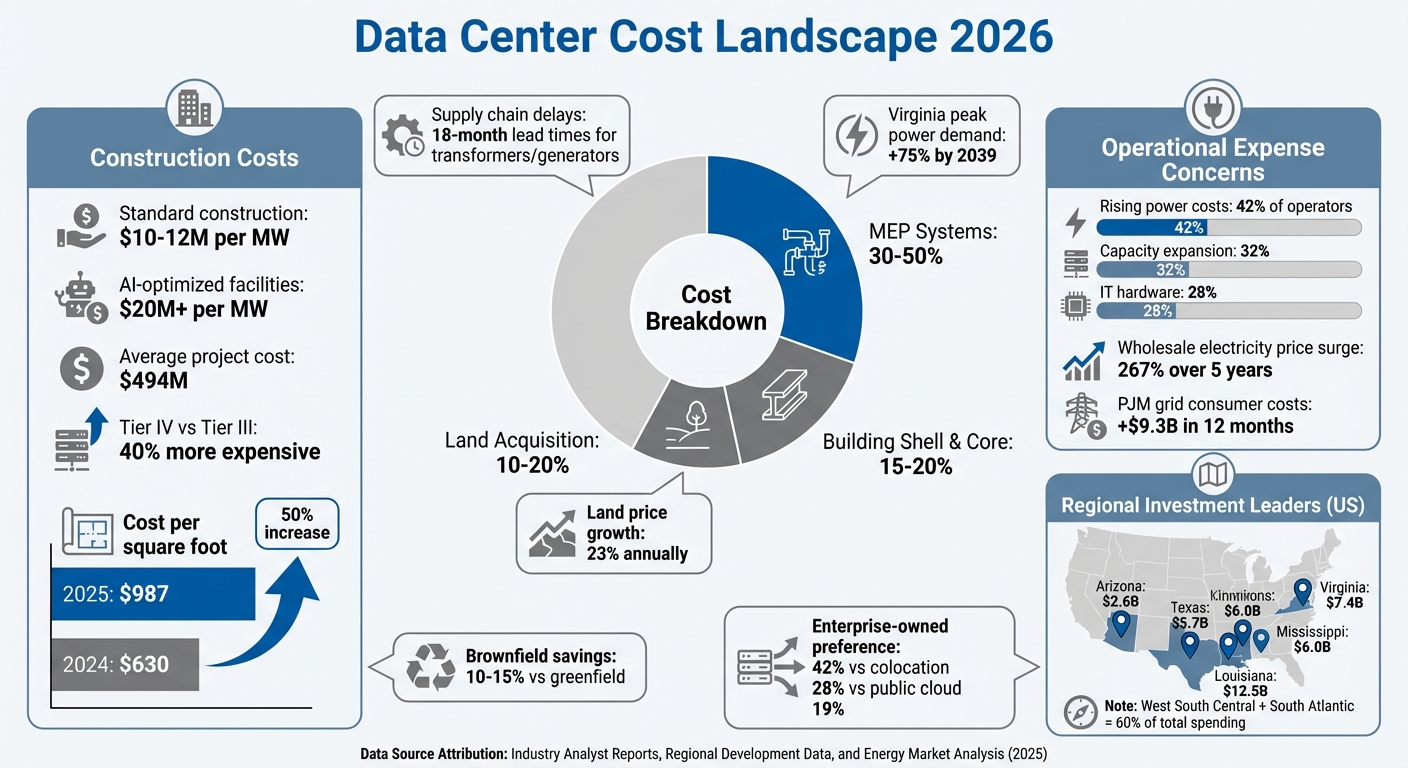
Building redundant data centers in 2026 comes with a hefty price tag. Standard construction costs range from $10–$12 million per megawatt (MW), but for AI-optimized facilities, that figure skyrockets to $20+ million per MW. On average, projects are hitting $494 million, reflecting the growing complexity and scale of these operations.
A major chunk of these costs – 30–50% – goes to Mechanical, Electrical, and Plumbing (MEP) systems. These systems include essential backup generators, uninterruptible power supplies (UPS), power distribution units (PDUs), and cooling infrastructure, all of which are critical to ensuring redundancy. The building’s shell and core, which cover site preparation, structural components, and security systems, account for another 15–20% of the budget. Land acquisition adds 10–20%, with land prices rising by about 23% annually.
The redundancy tier also plays a big role in driving up costs. For example, Tier IV facilities cost roughly 40% more than Tier III, thanks to stricter infrastructure and security standards. Construction costs on a per-square-foot basis have climbed steeply as well, reaching $987 by late 2025 – a 50% jump from $630 in 2024.
"Data centers are becoming significantly more expensive to build on a per-square-foot basis… the cost per square foot now averages $987, a 50% increase from just a year ago." – Michael Guckes, Chief Economist at ConstructConnect
Operational expenses are another major hurdle. Rising power costs are a top concern for 42% of operators, followed by capacity expansion (32%) and IT hardware (28%). Wholesale electricity prices have surged 267% over the past five years, with the PJM Interconnection grid seeing consumer power costs rise by over $9.3 billion in just 12 months starting June 2025. Much of this increase is tied to the growing demand for AI infrastructure.
These cost factors vary widely depending on the region, further complicating budgeting and planning.
Regional Cost Variations and Industry Benchmarks
Regional factors significantly influence data center costs, making location a critical consideration for scalable redundancy.
Geography plays a huge role in shaping both construction and operational expenses. In terms of investment, Louisiana leads the U.S. with $12.5 billion in year-to-date spending as of October 2025. Other major players include Virginia ($7.4 billion), Mississippi ($6.0 billion), Texas ($5.7 billion), and Arizona ($2.6 billion). Together, the West South Central and South Atlantic regions account for nearly 60% of all spending, thanks to favorable conditions like reliable power availability and tax incentives.
Virginia’s "Data Center Alley" highlights some of the challenges and pressures of regional demand. Peak power demand in this area is projected to rise 75% by 2039, forcing developers to explore new markets. These shifts often require significant investments in grid upgrades or even onsite power generation.
"We believe data centers should pay for the full cost of their power. That’s how we design our rates, and it’s the standard our regulator uses." – Aaron Ruby, spokesperson for Dominion Energy
Another factor to consider is the choice between greenfield and brownfield development. Repurposing existing warehouses or manufacturing facilities can save 10–15% compared to building new facilities, but availability varies by location. Owning data centers also remains an attractive option for many operators – 42% find it cheaper to run workloads in their own facilities compared to colocation (28%) or public cloud (19%). However, the upfront capital requirements are steep, and supply chain delays, such as 18-month lead times for transformers and generators, add further challenges.
Scalability Challenges and Solutions
Challenges in Scaling Redundant Systems
Scaling redundant data centers in 2026 comes with a host of challenges that extend far beyond just rising costs. One of the biggest hurdles? Power and grid limitations. With grid capacity stretched thin and interconnection timelines dragging on, securing enough electricity has become a major obstacle. This has led some developers to explore alternative energy sources like natural-gas turbines or even nuclear power to keep their operations running. These power constraints only add to the complications of traditional redundancy models.
At gigawatt scales, conventional redundancy designs like N+1 or 2N start to break down. They introduce overwhelming complexity and drive costs through the roof. The result? Skyrocketing equipment demands that inflate both capital expenditures and operational budgets.
"At giga scale, additional layers of redundancy result in additional costs and complexity for data center construction, commissioning, and operation." – McKinsey & Company
The rise of high-density AI workloads makes things even trickier. Modern AI racks generate so much heat that air-cooling systems just can’t keep up anymore. Operators are now forced to choose between liquid and immersion cooling systems – decisions that require specialized expertise, which is increasingly hard to find. In fact, 66% of operators report struggling to hire or retain qualified staff.
Supply chain issues only add fuel to the fire. Delays in getting transformers and switchgear, combined with new tariffs, have pushed equipment costs up by 5–10%. Together, these factors have created a perfect storm, with 32% of operators identifying capacity expansion costs as a top driver of rising expenses. These challenges make it clear: redundancy models need a fresh approach, and the following strategies offer potential solutions.
Methods for Cost-Effective Scalability
Tackling these challenges requires smarter, more efficient strategies that address both technical and financial pain points. One promising solution? Modular and standardized designs. By standardizing 60% to 80% of their infrastructure, companies can streamline procurement, reduce supply chain risks, and speed up deployment. This approach transforms custom engineering projects into repeatable, scalable industrial products that work globally.
Another effective method is sequential phasing. Instead of building full-scale capacity upfront, operators can expand data halls in stages, aligning growth with actual demand. This phased approach keeps initial costs in check while leaving room for future upgrades. Consolidating mechanical, electrical, and plumbing (MEP) systems into auxiliary units makes this strategy even more practical and cost-effective.
Perhaps the most game-changing savings come from rethinking redundancy. Instead of duplicating systems for every building, campus-level redundancy integrates backup systems across an entire facility. This approach slashes equipment needs and simplifies operations at scale. A prime example? In December 2024, Meta unveiled a 4-million-square-foot, 2GW data center campus in Louisiana, specifically designed for AI and high-performance computing.
For operators willing to think outside the box, brownfield redevelopment can provide immediate cost benefits. By repurposing existing warehouses or manufacturing sites, companies like QTS Realty Trust have achieved a 10% to 15% cost advantage over building brand-new facilities. While opportunities vary by location, this strategy can save millions in construction costs.
And for businesses not ready to invest in their own facilities, colocation services offer a flexible, scalable alternative. With a "pay-as-you-grow" model, colocation eliminates the need for massive upfront investments. Although 28% of operators find colocation more cost-effective compared to 42% who prefer enterprise-owned facilities, colocation still provides standardized redundancy and managed services, easing staffing demands. Engaging contractors early through collaborative contracting can also trim 3% to 5% off capital expenses by leveraging their expertise in site selection and design.
sbb-itb-59e1987
Future Cost Trends for Redundant Data Centers
Technology Developments Affecting Costs
Emerging technologies like liquid cooling – specifically Direct-to-Chip (DTC) and immersion systems – are poised to significantly reduce Power Usage Effectiveness (PUE) to as low as 1.1. With AI workloads driving rack densities beyond 100 kW, these cooling methods are becoming critical for cutting operational costs. This shift is particularly relevant as 42% of operators report that rising power costs are their most significant expense increase.
Another game-changer is the adoption of modular and prefabricated construction methods. By moving away from traditional "stick-build" practices and embracing integrated modules – similar to those used in industries like oil and gas – operators can relocate labor off-site and speed up project timelines by 10% to 20%. When paired with standardized reference designs (which use 60% to 80% standardized components), this approach streamlines procurement and mitigates supply chain risks. Together, these advancements could cut global data center spending by as much as $250 billion by 2030.
Additionally, 4D generative scheduling tools are helping to shorten project timelines by up to 20%. This is a big advantage, especially as power availability increasingly dictates site selection over traditional location considerations. These innovations are setting the stage for significant shifts in both capital and operational costs across the industry.
Market Trends and Industry Expectations
With these advancements, capital expenditures on data center infrastructure are expected to surpass $1.7 trillion by 2030. Hyperscalers alone are projected to spend $300 billion in 2025. In the U.S., power capacity demands are expected to triple, jumping from 25 GW in 2024 to over 80 GW by 2030. This growth will fundamentally change how redundancy is planned and implemented.
As grid limitations become more pronounced, operators are turning to on-site energy generation to manage costs and avoid long grid connection delays, which can stretch beyond four years. Investments in private energy generation and battery storage are gaining traction, especially in regions like EMEA, where renewable energy projects with private transmission lines can cut power costs for tenants by up to 40%. Meanwhile, hyperscale tenants are increasingly moving away from natural gas in favor of sustainable energy solutions, driven by corporate environmental goals and growing regulatory pressures. This trend is expected to gain even more momentum in the coming years.
Conclusion
As construction costs rise and capital expenditures surge, organizations must rethink their infrastructure planning strategies. The traditional approach of per-building redundancy simply doesn’t hold up at gigawatt scales anymore. Instead, a campus-level integration approach has become essential to address these challenges effectively.
This shift demands a focus on three core strategies: standardization, modularization, and smart power planning. By standardizing 60% to 80% of designs, incorporating integrated MEP (mechanical, electrical, and plumbing) modules, and ensuring secure power access, businesses can reduce capital expenses by as much as 10% to 20% while speeding up deployment timelines. However, securing sufficient power has emerged as the most pressing hurdle, with grid connection delays pushing operators to seek alternative solutions.
"Overinvesting in data center infrastructure risks stranding assets, while underinvesting means falling behind." – Jesse Noffsinger, Mark Patel, and Pankaj Sachdeva, McKinsey & Company
To stay competitive, IT professionals and business leaders need to act decisively. This means engaging with utilities early to secure behind-the-meter generation, locking in capacity through pre-leasing agreements, and designing facilities that can accommodate future technologies like liquid cooling – even for non-AI applications. With power costs now cited as the largest expense increase by 42% of operators and AI infrastructure setups reaching $25 million per megawatt, proactive planning is no longer optional – it’s essential.
FAQs
What are the most cost-effective ways to scale redundant data centers?
Scaling redundant data centers effectively means finding the right balance between cost, growth potential, and reliability. To achieve this, businesses can focus on a few smart strategies: using colocation services, adopting modular designs, and improving power and staffing efficiency.
Colocation services let companies share infrastructure costs, cutting down on the hefty upfront expenses of building and maintaining their own facilities. At the same time, modular designs allow for gradual, step-by-step growth, eliminating the need for large-scale construction projects when expansion is necessary.
On the operational side, reducing power consumption is key. This can be achieved by integrating advanced cooling systems, switching to renewable energy sources, and using high-efficiency equipment. For staffing, remote management tools help streamline operations, reducing the need for large on-site teams and lowering overhead costs.
By combining these strategies, businesses can scale their data centers in a way that keeps costs manageable while supporting growth. Companies like Serverion provide globally distributed colocation facilities that are energy-efficient and designed to grow with your needs, making it easier to expand without breaking the bank.
What factors influence the cost of building redundant data centers in different regions?
Regional factors greatly influence the cost of building redundant data centers across the U.S. One major factor is land pricing, which varies significantly depending on location. In 2024, the average cost for data center land was $5.59 per square foot (approximately $244,000 per acre). Meanwhile, larger parcels in newer markets saw a jump to $5.40 per square foot, marking a 23% increase compared to 2023. Established hubs like Northern Virginia often grapple with power limitations, prompting developers to explore less saturated areas where costs are generally lower.
Other elements, such as labor, supply chain logistics, and energy prices, also affect expenses. Rising wages, material shortages, and increased electricity rates can all drive up costs. Additionally, local climate and natural risks shape design requirements – for instance, hotter regions may require advanced cooling systems, while seismic zones demand reinforced structures. To help businesses manage these challenges, Serverion offers colocation services across various U.S. data center locations, allowing companies to balance costs while maintaining redundancy and reliability for essential operations.
What new technologies could help lower operational costs for data centers in the future?
Emerging technologies are set to drastically lower the operational costs of data centers. AI-powered tools are leading the charge by keeping a close eye on energy consumption, cooling systems, and workloads in real time. These tools can make automatic adjustments to minimize waste and reduce the need for extensive staffing. On top of that, renewable energy sources – like solar panels, wind turbines, and on-site microgrids – are stepping in to replace pricey grid electricity with more affordable and cleaner alternatives.
Data centers are also benefiting from smarter infrastructure designs. Modular and prefabricated components make it easier for operators to scale up as needed, all while keeping construction costs in check. Meanwhile, the rise of edge computing and distributed AI models is shifting some of the workload away from centralized hubs. This reduces the need for long-distance data transmission and lowers cooling requirements. Together, these innovations are shaping a future of more efficient, cost-effective, and environmentally friendly data center operations.