
SDN vs. Traditional Networking: Key Differences

Which is better: SDN or traditional networking? It depends on your needs. SDN centralizes network control, making it easier to manage and scale. It uses software to automate processes and reduce reliance on expensive, proprietary hardware. Traditional networking, on the other hand, relies on hardware-driven control, with each device configured manually. While this approach is reliable for smaller, stable networks, it struggles to keep up with dynamic environments.
Key Highlights:
- Control: SDN centralizes decision-making in software, while traditional networking relies on distributed, device-specific control.
- Scalability: SDN scales through software adjustments, whereas traditional networks require adding and configuring new hardware.
- Cost: SDN lowers costs by using standard hardware (white-box switches), compared to traditional networks’ reliance on proprietary equipment.
- Management: SDN simplifies management with automation and APIs, while traditional setups require manual configuration for each device.
- Security: SDN enables quick, network-wide policy updates and micro-segmentation. Traditional systems require manual, device-by-device updates.
Quick Comparison:
| Feature | SDN | Traditional Networking |
|---|---|---|
| Control | Centralized through a controller | Distributed across devices |
| Configuration | Automated via APIs | Manual, device-by-device |
| Hardware | Uses standard, open hardware | Requires proprietary equipment |
| Scalability | Software-based | Hardware-based |
| Security | Centralized policies, micro-segmentation | Manual updates, perimeter-based security |
| Cost | Lower (commodity hardware) | Higher (proprietary hardware) |
If your network is large, changes frequently, or requires automation, SDN is a better fit. For smaller, stable environments, traditional networking remains a solid choice. Pick based on your organization’s size, complexity, and future growth plans.
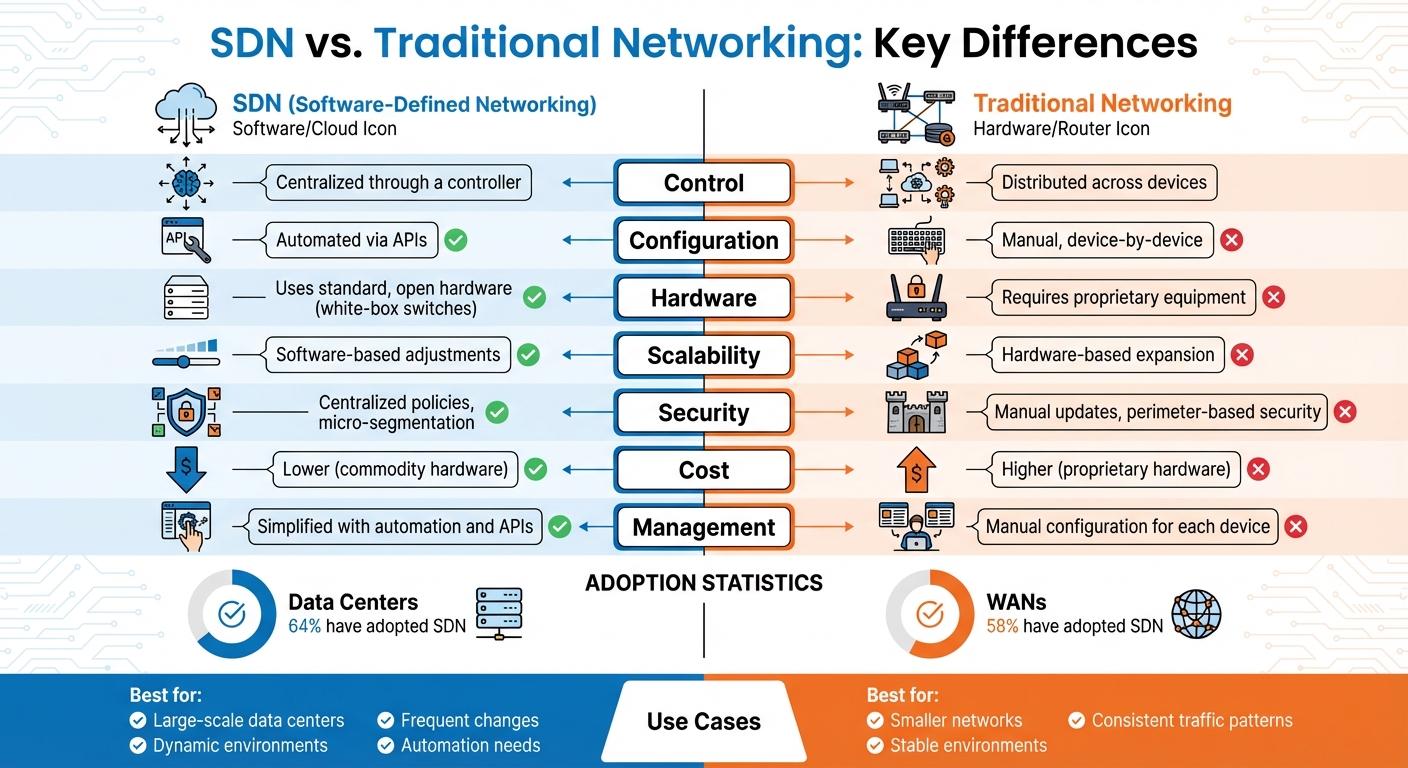
SDN vs Traditional Networking: Complete Feature Comparison
SDN Explained | Traditional Networking vs SDN | Northbound & Southbound Interface Made Simple
What is Traditional Networking?
Traditional networking is a hardware-focused approach that has been the backbone of enterprise IT for decades. This model depends on physical devices like routers, switches, and firewalls to manage and direct network traffic. Each device operates independently, making decisions based on its own logic and the status of nearby devices.
A key feature of traditional networking is the integration of the control plane and data plane. Think of the control plane as the "brain" that decides how traffic should flow and the data plane as the "muscle" that forwards the packets. Because these two functions are combined within the same device, decision-making and data forwarding are tightly linked. As Brian McGahan from INE explains:
Traditional networking relies on manually configuring and managing individual devices separately… This model has been the standard for decades.
In this setup, network intelligence is distributed across all devices. Each router or switch functions on its own, without a centralized understanding of the entire network. When changes are needed – like updating security policies or rerouting traffic – administrators must configure each device one by one, typically through a command-line interface (CLI).
The functionality of traditional networking is built into Application-Specific Integrated Circuits (ASIC) and other specialized hardware. These devices use well-established protocols like TCP/IP and Ethernet, offering reliable performance in environments with stable requirements.
However, the rigid nature of this model presents challenges in today’s fast-changing business world. Troubleshooting often involves a time-consuming "hop-by-hop" process, where engineers check each device along the path to identify issues. Scaling the network requires purchasing and installing new hardware, followed by manual configuration to ensure compatibility with the existing setup. This reliance on physical equipment and manual processes makes it difficult for traditional networking to meet the agility and speed that modern organizations demand. These challenges have paved the way for newer solutions like SDN.
What is Software-Defined Networking (SDN)?
Software-Defined Networking (SDN) shifts the way networks operate by separating network control from data forwarding. Instead of relying on individual devices to make decisions, SDN centralizes this intelligence in software that manages the entire network. As explained by the Open Networking Foundation:
Software-Defined Networking (SDN) is an emerging network architecture where network control is decoupled from forwarding and is directly programmable.
This approach relies on standardized protocols like OpenFlow, which acts as a universal language. OpenFlow allows the central controller to communicate with switches and routers from various vendors, eliminating the dependency on proprietary systems tied to specific manufacturers. The controller provides a global view of the network, treating thousands of devices as a unified system rather than individual components that require manual coordination. This centralized perspective is particularly useful in today’s fast-paced, data-driven environments.
SDN architecture is built around two main API layers:
- Northbound APIs: These connect the controller to applications and policy engines, enabling higher-level management and decision-making.
- Southbound APIs: Using protocols like OpenFlow, these send instructions from the controller to the hardware, ensuring seamless communication.
This setup allows for programmability, making it possible for administrators to automate network configurations and updates through software instead of manually accessing each device.
As businesses increasingly demand flexibility in virtualized and dynamic environments, SDN adoption is gaining momentum. It’s especially effective in data centers where virtual machines frequently move and where "east-west" traffic – data flowing between servers – dominates. By centralizing management, SDN transforms time-consuming, device-specific tasks into quick, automated processes. Changes that once took hours can now be completed in minutes, thanks to streamlined workflows and automation.
Architecture Differences
SDN and traditional networking take fundamentally different approaches to organizing control and data functions. In traditional networks, the control plane (responsible for decision-making) and the data plane (handling packet forwarding) are tightly bound within each hardware device. Every router and switch operates independently, making traffic decisions based on its local configuration and knowledge of direct neighbors.
SDN, on the other hand, separates these functions, moving the control logic to a centralized software-based controller that oversees the entire network. This controller provides a comprehensive, top-down view of the infrastructure. As Mike Capuano, former Chief Marketing Officer at Pluribus Networks, put it:
At its heart, SDN has a centralized or distributed intelligent entity that has an entire view of the network, that can make routing and switching decisions based on that view.
This shift in architecture changes how networks are managed. Traditional networks rely on manual configuration of each device through Command-Line Interface (CLI), a process that can be both time-consuming and prone to errors. In contrast, SDN allows for automated, policy-driven configuration across the network using APIs. The controller communicates with hardware through Southbound APIs (such as OpenFlow, NETCONF, and gRPC) and connects to applications and management tools via Northbound APIs for higher-level operations.
Another key difference lies in hardware. Traditional networks depend on proprietary devices with built-in intelligence, often powered by ASICs. SDN, however, uses commodity hardware, commonly referred to as white-box switches, because the intelligence resides in software rather than the physical equipment. This abstraction turns physical devices into a flexible resource pool, managed through software instead of manual adjustments.
Architecture Comparison Table
| Feature | Traditional Networking | Software-Defined Networking (SDN) |
|---|---|---|
| Control Plane Location | Distributed (on each device) | Centralized (software-based controller) |
| Configuration Method | Manual CLI on individual devices | Centralized, automated via APIs |
| Control/Data Plane | Tightly integrated in hardware | Decoupled and separated |
| Protocol Usage | Proprietary and standard protocols (BGP, OSPF, SNMP) | Open protocols (OpenFlow, NETCONF, gRPC, RESTful APIs) |
| Hardware Dependency | Proprietary, fixed-function hardware | Commodity hardware (white-box switches) |
| Network View | Device-level (local neighbor awareness) | Global (entire network view) |
| Intelligence | Hardware-driven (ASICs) | Software-driven |
These architectural differences lay the foundation for understanding how SDN and traditional networks manage and control traffic in distinct ways.
Management and Control
When comparing traditional networks to Software-Defined Networking (SDN), their methods of management and control highlight a clear operational divide. In traditional setups, network administrators must manually configure each device using a Command-Line Interface (CLI). This process is tedious, error-prone, and often leads to outages or security vulnerabilities due to human mistakes.
SDN takes a completely different approach with its centralized management model. Instead of logging into individual devices, administrators use a software-based controller to manage the entire network from a single interface. Through APIs and templates, policies and configurations can be applied across hundreds of devices simultaneously. This shift introduces Infrastructure as Code (IaC), allowing network policies to be treated like software code, which can be integrated into DevOps workflows for Continuous Integration/Continuous Deployment (CI/CD).
Take the City of Luxembourg as an example. In 2020, under the guidance of Frank Weiler, Head of the Networking Department, the city implemented Cisco SD-Access. This transformation automated segmentation and security policy deployment, reducing the time required by up to 10 times. Frank Weiler highlighted the efficiency gains:
"With Cisco SD-Access, we can automate and apply segmentation and security policies to our network devices up to 10 times faster than before."
When it comes to troubleshooting, the differences are just as stark. Traditional networks require engineers to manually collect data from individual devices to identify and resolve issues. In contrast, SDN controllers provide real-time, network-wide visibility with integrated monitoring tools. These tools enable centralized packet capture and flow analysis, simplifying diagnostics. For instance, during the University of Derby’s 2020 transition to remote work, Principal Infrastructure Engineer Richard Lock credited their SDN solution for enabling a seamless shift of their virtual learning environment and staff to work-from-home setups.
Centralized vs. Distributed Control
The core difference between traditional and SDN networks lies in how they handle control. Traditional networks rely on distributed control, where each device operates independently, making traffic decisions based solely on its local configuration and immediate surroundings. This fragmented approach limits the network’s ability to quickly adapt to changing conditions, such as traffic surges or failures.
SDN, on the other hand, uses centralized control, consolidating network intelligence into a single software controller. This controller maintains a global view of the network, enabling dynamic traffic management. For example, it can reroute traffic in real time based on factors like latency or packet loss. Additionally, the controller can validate configurations before deploying them, reducing the chances of errors that could disrupt operations. While centralization introduces the risk of a single point of failure, redundancy and automatic failover mechanisms are built into SDN systems to address this concern. This centralized approach not only simplifies management but also paves the way for greater scalability and automation.
sbb-itb-59e1987
Scalability and Agility
As networks grow, the contrast between traditional networking and Software-Defined Networking (SDN) becomes impossible to overlook. Expanding a traditional network often involves purchasing additional physical switches and routers, installing them in server racks, and configuring each device manually using CLI commands. This process is not only time-consuming and costly but also becomes increasingly complicated as the network scales. While managing a handful of devices is manageable, scaling to hundreds or thousands creates a logistical nightmare.
SDN takes a completely different approach. Instead of relying on new hardware, network expansion is achieved through software adjustments, making the process far simpler and more efficient. With a centralized controller, managing 1,000 routers is as straightforward as managing just 10. For instance, when Kolmar Korea revamped their campus network in 2020 using Cisco SD-Access, they achieved seamless Layer 2 roaming and full IP mobility. The SDN model enabled their small IT team to oversee the entire infrastructure using automated insights, drastically reducing the time and expenses associated with manual device configuration.
Traffic adaptability is another area where SDN shines. Traditional networks are inherently static, meaning any shifts in traffic patterns or congestion require engineers to manually update routing tables and policies across multiple devices. SDN, on the other hand, dynamically adjusts to real-time conditions such as latency or packet loss. This adaptability allows data to be rerouted automatically, supporting the rapid scaling of temporary workloads without requiring human intervention – an essential capability in today’s fast-paced data centers. The table below highlights these scalability differences.
The hardware requirements further illustrate the divide. Traditional networks often lock organizations into using proprietary, fixed-function hardware from specific vendors, creating dependency and limiting flexibility. In contrast, SDN separates the control plane from the physical infrastructure, enabling the use of standard, open networking equipment (commonly referred to as white-box switches). This abstraction not only reduces costs but also eliminates vendor lock-in, all while maintaining high performance.
Scalability Comparison Table
| Feature | Traditional Networking | Software-Defined Networking (SDN) |
|---|---|---|
| Resource Provisioning Speed | Slow; requires manual hardware setup and CLI configuration | Fast; automated via centralized software controller |
| Hardware Dependency | High; relies on proprietary, fixed-function hardware | Low; supports standard, open networking hardware |
| Traffic Adaptability | Static; requires manual rerouting during congestion | Dynamic; real-time automated traffic adjustments |
| Scalability Method | Physical; adding more hardware devices | Logical; software-based adjustments and virtualization |
| Management Complexity | Increases exponentially with each new device | Remains consistent through algorithmic management |
Cost Efficiency and Automation
When it comes to cost efficiency, SDN stands out as a game-changer compared to traditional networking. Traditional networks often come with hefty upfront costs, requiring proprietary hardware where control and data planes are tightly integrated into specialized ASICs. Scaling such networks means buying more equipment, which drives up capital expenses. In contrast, SDN leverages standard white-box switches, significantly cutting costs. For instance, SDN-compatible hardware from FS includes options like the S3410C-16TF (16-Port Gigabit L2+) priced at $339.00, the S3410-48TS (48-Port Gigabit L2+) at $1,089.00, and the S5810-48FS (48-Port Gigabit L3 with 10Gb Uplinks) at $2,529.00. These prices are far more competitive than proprietary alternatives, making SDN an attractive choice for organizations aiming for a leaner, more flexible infrastructure.
Operational expenses (OpEx) are another area where SDN shines. Traditional networks require manual, device-specific configuration through CLI, which not only consumes IT resources but also increases the risk of human error – potentially leading to costly downtime. SDN eliminates this by centralizing management through APIs, enabling network-wide changes with ease. In one reported case, policy deployments became 10 times faster thanks to automation. This efficiency reduces labor costs and accelerates implementation timelines.
SDN also simplifies complex network configurations. Controllers utilize Northbound APIs to interact with business applications, allowing developers to define network behavior through software rather than manually tweaking hardware. By adopting an Infrastructure as Code (IaC) approach, SDN supports scalable and repeatable DevOps workflows. Organizations can set high-level business policies that the controller translates into precise technical configurations across the network. It even performs logic checks before deployment and provides automated rollback features to minimize downtime risks. The table below highlights how SDN outperforms traditional networking in terms of cost and automation.
Cost and Automation Comparison Table
| Feature | Traditional Networking | Software-Defined Networking (SDN) |
|---|---|---|
| CapEx | High; proprietary, fixed-function hardware required | Lower; uses open hardware and software licenses |
| OpEx | High; manual CLI configuration and skilled labor per device | Lower; centralized automation minimizes manual effort |
| Scaling Investment | Requires purchasing additional physical equipment | Adjustments made through software and virtualization |
| Automation Capability | Limited; manual updates and proprietary tools | High; programmable via APIs and IaC |
| Vendor Lock-in | Strong reliance on a single manufacturer | Reduced; supports open protocols and multiple vendors |
| Troubleshooting Efficiency | Time-consuming; device-by-device diagnosis | Streamlined with centralized monitoring and real-time analysis |
Performance and Security in Data Centers
Data centers demand both high performance and stringent security measures, and the way these are managed differs significantly between traditional networking and Software-Defined Networking (SDN). Traditional networks rely on static routing tables and manual configurations, meaning each device – whether a router or a switch – makes decisions based on its immediate surroundings. When issues like congestion or security threats arise, IT teams must manually adjust settings on individual devices, leading to delays and inefficiencies, especially during critical moments. This is where SDN’s integrated and automated approach changes the game.
SDN uses a centralized controller to oversee the entire network, offering real-time monitoring and decision-making. This global perspective allows SDN to automatically reroute traffic around congested areas or failed links, optimizing latency without requiring human intervention. On the security front, SDN shines with centralized policy enforcement. Administrators can instantly apply consistent firewall rules and access controls across all devices, saving time and reducing errors. For example, in 2020, Frank Weiler, Head of the Networking Department at the City of Luxembourg, adopted Cisco SD-Access to manage the city’s rapid digital transformation. This implementation enabled the city to automate segmentation and enforce security policies across network devices 10 times faster than with their previous traditional setup.
Another standout feature of SDN is micro-segmentation, which isolates workloads to contain potential threats. If a security breach is detected, the SDN controller can immediately quarantine affected devices across the network. Traditional networks, by contrast, require manual reconfiguration of multiple devices to achieve the same result. Kolmar Korea experienced this firsthand when IT Senior Manager Howon Lee implemented Cisco SD-Access across their campus. The SDN deployment provided seamless Layer 2 roaming, full IP mobility, and automated assurance tools, significantly reducing troubleshooting time and operational costs for their lean IT team.
While SDN’s centralized controller offers unparalleled visibility and control, it does come with a trade-off: it can become a single point of failure. If the controller is compromised or goes offline, it can disrupt the entire network. To mitigate this risk, data centers relying on SDN architecture must prioritize high-availability planning and redundant controller setups.
Performance and Security Comparison Table
| Feature | Traditional Networking | Software-Defined Networking (SDN) |
|---|---|---|
| Latency Optimization | Static; relies on fixed hardware paths and manual rerouting | Dynamic; real-time monitoring reroutes traffic to the fastest available path |
| Traffic Engineering | Manual CLI configuration on a device-by-device basis | Automated; centralized controller manages global traffic flows via APIs |
| Security Policy Enforcement | Distributed; policies must be manually updated on each firewall/switch | Centralized; policies are pushed to all devices simultaneously from one interface |
| Threat Isolation | Manual; requires reconfiguring multiple switches/routers to quarantine a segment | Instant; software-defined rules can isolate affected devices or flows automatically |
| Visibility | Fragmented; requires logging into multiple devices to see the "big picture" | Centralized dashboard providing full network visualization and analytics |
| Security Model | Perimeter-based; difficult to isolate internal lateral movement | Zero Trust; enables granular micro-segmentation of workloads |
Trade-offs and Use Cases
Choosing between SDN and traditional networking isn’t about declaring a winner – it’s about finding the right fit for your specific needs and environment. SDN thrives in large-scale data centers, cloud environments, and organizations that require quick application deployment. If your network frequently changes, needs multi-tenant isolation, or relies on automation to minimize human error (a leading cause of network downtime), SDN’s centralized controller and programmable infrastructure offer clear benefits.
However, SDN’s advantages come with certain challenges. The centralized controller, while powerful, can also be a single point of failure – a risk that could jeopardize the entire network if it goes offline or is compromised. To mitigate this, organizations must plan for high availability, implement redundant controllers, and develop robust disaster recovery strategies. Additionally, transitioning to SDN introduces complexity. Teams accustomed to CLI-based device management will need to learn APIs, automation frameworks, and software orchestration tools. For smaller offices or stable networks with minimal changes, this level of restructuring may not be worth the effort or cost.
On the other hand, traditional networking remains a solid choice for smaller, less dynamic environments where simplicity and consistent performance take priority over flexibility. If your IT team is already skilled in managing hardware-centric networks and your setup doesn’t require frequent policy updates, the distributed control model offers reliability without the added complexity of centralized software controllers. Plus, traditional networks sidestep the potential latency issues that can arise as SDN controllers scale to manage thousands of devices.
SDN’s ability to quickly adapt to sudden demands – like traffic spikes or urgent policy changes – makes it invaluable in dynamic environments where manual configurations could slow things down. In contrast, traditional networking often requires physical hardware upgrades to handle increased demand, while SDN can achieve the same results through software adjustments.
When deciding on a networking approach, consider factors like scale, how often your network changes, and your team’s expertise. Interestingly, 64% of data centers and 58% of WANs have adopted SDN, reflecting a shift toward software-defined infrastructure. That said, for organizations managing smaller, stable networks, traditional networking’s reliability and straightforward setup may still be the better choice. Ultimately, the key lies in aligning your network architecture with your business’s unique demands.
Conclusion
Choosing between SDN and traditional networking boils down to matching your network’s architecture to your organization’s specific needs. Traditional networking shines with its straightforward reliability, making it ideal for smaller setups with steady traffic patterns and teams well-versed in CLI-based management. On the other hand, SDN thrives in dynamic, large-scale settings, where the benefits of automation, centralized control, and rapid provisioning outweigh the investment in new tools and expertise. This comparison highlights the critical differences discussed throughout this article.
As noted earlier, SDN’s centralized architecture offers a unified view of the network, enabling smarter routing and switching decisions across the entire system. This contrasts sharply with the device-by-device approach of traditional networking. For data centers juggling thousands of devices and frequent configuration changes, SDN’s centralized control becomes invaluable.
While the industry is increasingly leaning toward SDN, traditional networking isn’t fading into irrelevance. For organizations with stable networks, infrequent changes, and teams deeply experienced in hardware-centric management, the complexity of centralized controllers and API-based automation might not justify the switch.
When deciding, consider your organization’s growth plans, operational needs, and team expertise. If your network demands frequent updates, robust isolation, or tight integration with DevOps workflows, SDN’s programmable features offer clear benefits. However, if your network is stable, your team is comfortable with existing tools, and you value straightforward troubleshooting over automation, traditional networking remains a solid choice.
Ultimately, neither approach is inherently better – they’re designed for different use cases. The key is to evaluate your current needs and future goals to choose the best strategy for your network’s evolution.
FAQs
What makes SDN more scalable than traditional networking?
Software-Defined Networking (SDN) makes scaling networks much easier by shifting control to a software-based controller. By separating the control plane from the hardware, administrators can manage network growth through software updates and open APIs. This means adding new devices, virtual overlays, or extra capacity can be done without the hassle of manual configurations or relying on specific hardware.
Traditional networking, on the other hand, ties control tightly to hardware. Scaling in such setups often involves physically installing new devices and configuring each one manually – a process that’s not only time-consuming but also prone to mistakes. SDN’s programmatic approach simplifies this by enabling on-demand scaling, automating resource allocation, and smoothly adjusting to changing conditions, making it a much more efficient choice for expanding networks.
What makes SDN more secure than traditional networking?
Software-Defined Networking (SDN) strengthens security by giving administrators centralized control through a programmable controller. This setup ensures that all network devices – like switches and routers – adhere to consistent security policies in real time. Instead of configuring each device manually, administrators can define and update rules from one central location, reducing the chances of human error.
Another key advantage of SDN is its ability to provide detailed visibility into network traffic. This makes it easier to monitor activity, detect unusual behavior, and respond to threats quickly. By isolating or neutralizing risks immediately, potential damage can be kept to a minimum. For hosting providers such as Serverion, these capabilities translate into a more secure and robust infrastructure. Features like compliance enforcement, micro-segmentation, and automated threat responses become achievable without the complexities tied to traditional hardware-based networks. In short, SDN delivers a flexible and efficient way to enhance network security.
Is software-defined networking (SDN) a good fit for small businesses with simple and stable network needs?
For small businesses with simple and steady network demands, traditional networking often does the job just fine. SDN is more tailored for situations where scalability, adaptability, or advanced management tools are crucial – needs that smaller setups typically don’t encounter.
When your network is predictable and doesn’t require intricate configurations, traditional networking can help you cut costs and avoid unnecessary complications, all while effectively supporting your business operations.